Executive Summary
A hotel group does not buy trees; it buys one specification repeated across properties. Freeze a base spec of five locked parameters — frond material, core diameter and coating, leaf density band, fire classification and colour tolerance — then allow only height, planter finish and fixing detail to vary by property. Groups that do this run 3–5 core models instead of 20-plus SKUs, cut spare-part lines by roughly two thirds, and hold a phase-three delivery to the same colour and density as phase one. Groups that do not spend the second year explaining why the flagship lobby looks different from the airport property.
1. What Goes Wrong Without This
Multi-property procurement fails in a small number of predictable ways, and every one of them is cheaper to prevent at the specification stage than to correct after handover.
Each property writes its own spec. Six procurement files, six design intents, six sets of dimensions. The trees arrive and the group discovers it has six different palm heights, four trunk finishes and three planter colours. Guests will not articulate why the properties feel unrelated, but the brand team will, and the correction is a full replacement rather than a reupholstery.
The model is discontinued between phases. A group specifies a particular tree in year one and reorders the same reference in year three to find the mould has been retired, the frond colour has moved to a new pigment lot, or the supplier has changed the trunk lay-up. A specification written as a model number has no second source and no continuity. A specification written as a set of measurable requirements survives a model change, because the replacement can be measured against the same numbers.
Colour drifts container by container. Two batches of the same green, produced eight months apart, will differ. Without a retained physical sample and a stated tolerance, "the same colour" means whatever each property's engineer remembers. The failure becomes visible only when two trees stand in the same sightline, which in a hotel usually means the lobby and the lounge, two metres apart.
Spare parts multiply. Every distinct model needs its own replacement fronds, its own fixing plate and its own finish touch-up. A group running twenty SKUs across eight properties carries a parts inventory that no housekeeping team can manage, and a damaged frond in a resort sits unrepaired for months because the part number belongs to a property that closed for renovation.
The fire dossier does not follow the goods. Each property has its own consultant, its own submission and its own deadline. A group-level certificate that names a generic product, rather than the assembly and batch actually delivered, gets rejected at the third property even though it passed at the first. The remedy is a per-shipment document set, and that has to be designed into the supply agreement rather than requested after the fact.
One property buys locally to save a week. A single deviation destroys the standard. Once a property has substituted a cheaper tree in its lobby, the group standard is a document nobody follows, and the next property has a precedent for opting out.
2. The Decision Framework
This is the part worth copying into a procurement brief. Seven decisions, in order, and each one has a testable output.
1. Define the unit of purchase as a position, not a tree. A lobby arrival cluster is one position: two 5 m specimens, one 3 m specimen, planter specification, fixing condition, lighting condition. Writing the brief per position rather than per tree is what makes a property repeatable, because the second property can adopt the position and change only what its architecture forces it to change.
2. Split the spec into locked and variable columns. Locked: frond material and colour family, core diameter range, zinc coating thickness, leaf density band, fire classification, colour tolerance. Variable: finished height, planter size and finish, fixing method, base plate geometry. If a parameter is not explicitly in one column or the other, each property will treat it as variable by default.
3. Set a colour tolerance in numbers. Require a retained approved sample per colour family, held by the group rather than the property, and a measured colour difference against it. A ΔE of 2.0 or lower within a batch and 3.0 or lower between batches is a workable commercial band; without a number, every discussion is an opinion. Photographs are not evidence — the same tree photographs as three different greens under three lighting temperatures.
4. Collapse the model count before pricing. Count the distinct tree models the portfolio actually needs. Most groups find that four or five cover every position once heights are grouped into bands instead of being specified to the centimetre. Every model removed from the list removes a tooling setup, a MOQ threshold, a spare-parts line and a drawing set.
5. Write a per-property drawing pack against that property's structure. The base plate belongs to the slab, not to the tree. Each property supplies its structural condition — slab thickness, reinforcement, waterproofing, ceiling height, sprinkler layout, access route — and receives a drawing that reflects it. A group drawing used unchanged in six buildings is a change order waiting for the first pour.
6. Fix one acceptance sheet used by every property. Same checkpoints, same tolerances, same photo angles, same sign-off. When each property's engineer invents their own checklist, the group cannot compare what it received, and a defect that is acceptable in one building becomes a snag in another.
7. Budget spares as a percentage, not an afterthought. Three to five percent of the frond count per model, plus one spare fixing plate per fixing type, is a defensible planning figure. It costs a fraction of a replacement shipment and it removes the situation where one damaged frond takes a tree out of service for a season.
Two things should stay deliberately outside the standard: the statement piece in a flagship arrival, and any property where a heritage or design-protected interior overrides the group palette. Standardisation that cannot absorb two documented exceptions gets abandoned by the third property; the discipline is bending the spec on paper rather than letting each site improvise.
3. Numbers, Tiers and Timelines
The table below is a planning guide for group programmes, not a quotation. It assumes indoor positions plus a small number of covered terraces, and standard heights between 2.5 m and 8 m.
| Programme tier | Core models to run | SKUs if uncontrolled | Spec freeze | First shipment lead time | Spare stock |
|---|---|---|---|---|---|
| 3–5 properties, 30–60 trees | 3–4 | 12–18 | 3–4 weeks | 45–60 days from drawing approval | 3% of fronds |
| 6–10 properties, 70–140 trees | 4–5 | 20–30 | 4–6 weeks | 60–75 days, phased | 4% of fronds |
| 11–20 properties, 150–300 trees | 5 | 30–45 | 6–8 weeks | 75–90 days, two phases | 5% of fronds |
| 20+ properties, renovation cycle | 4–6 plus a refresh kit | 45+ | 8 weeks, then annual review | Rolling call-off | 5% plus one assembly per model |
Read the second and third columns together. The gap between them is the cost of not standardising: every extra SKU adds a tooling changeover, a separate inspection, a separate carton specification and a separate spare-parts line, and none of it shows up in a unit price comparison.
Timeline components that decide the programme more than the factory does:
- Spec freeze, 3–8 weeks. Includes sample rounds; each physical sample round is 10–15 working days including freight, and most groups need two rounds because the first confirms material and the second confirms colour.
- Drawing approval, 2–3 weeks per property. Runs in parallel across properties if the group supplies structural information to all of them at once. Run sequentially, it becomes three months.
- Production, 25–35 days for standard heights, 40–50 days above 6 m or with a custom finish. A phased programme should not compress this; compressing it is how a phase ships with a colour that does not match phase one.
- Sea freight, 20–30 days to Gulf ports, 7–12 days within Southeast Asia, plus 5–10 days port and customs. Landlocked destinations add the inland leg and a second handling event, which is where canopy damage usually happens.
- Installation, 1–3 days per property for a typical five-position package, scheduled outside trading hours in an operating hotel.
A group that plans the freeze, the drawings and the freight legs backward from each property's opening date will find the factories are rarely the constraint. The constraint is the week nobody booked for sample approval.
4. How to Apply It to a Live Project
The framework only works if each stage produces a document that the next stage can be measured against. Six stages, and the deliverable that has to exist before the stage closes.
Enquiry. Issue one group brief covering every property, with each position listed and the variable parameters flagged. Deliverable: a single response that prices the programme, not six responses that cannot be compared. Ask explicitly how the supplier would hold a colour across phases, because the answer separates a factory that retains samples from one that re-photographs each order.
Sampling. Request two samples per colour family, not one: one for the group to retain, one to travel to the next property. Deliverable: a signed sample record with the date, the batch reference and the colour reading. This single document prevents most of the phase-three colour arguments.
Drawings. Supply structural data per property and receive a drawing per property. Deliverable: an approved drawing set with revision numbers, tied to the property it belongs to. A drawing without a property reference will be used in the wrong building.
Production. Require photographs at three points: frame and core before dressing, canopy at full density, and packed cartons with the property label applied. Deliverable: a per-property packing list mapped to the drawing revision. At group scale the labelling is not administrative; it is what lets a receiving team at a live hotel put the right tree in the right atrium without opening every carton.
Shipping. Consolidate where the calendar allows, split where it does not. Deliverable: a stowage plan per container with the property allocation marked, plus the inspection record for each phase. Groups that ship everything at once to save freight usually pay for it in warehousing at a working hotel with a small dock.
Installation and handover. One acceptance sheet, one photo set per position, one signed record per property. Deliverable: a group-level register of what was installed where, with model, batch and fixing type. That register is the only thing that makes year-three replacement a purchase order instead of an investigation.
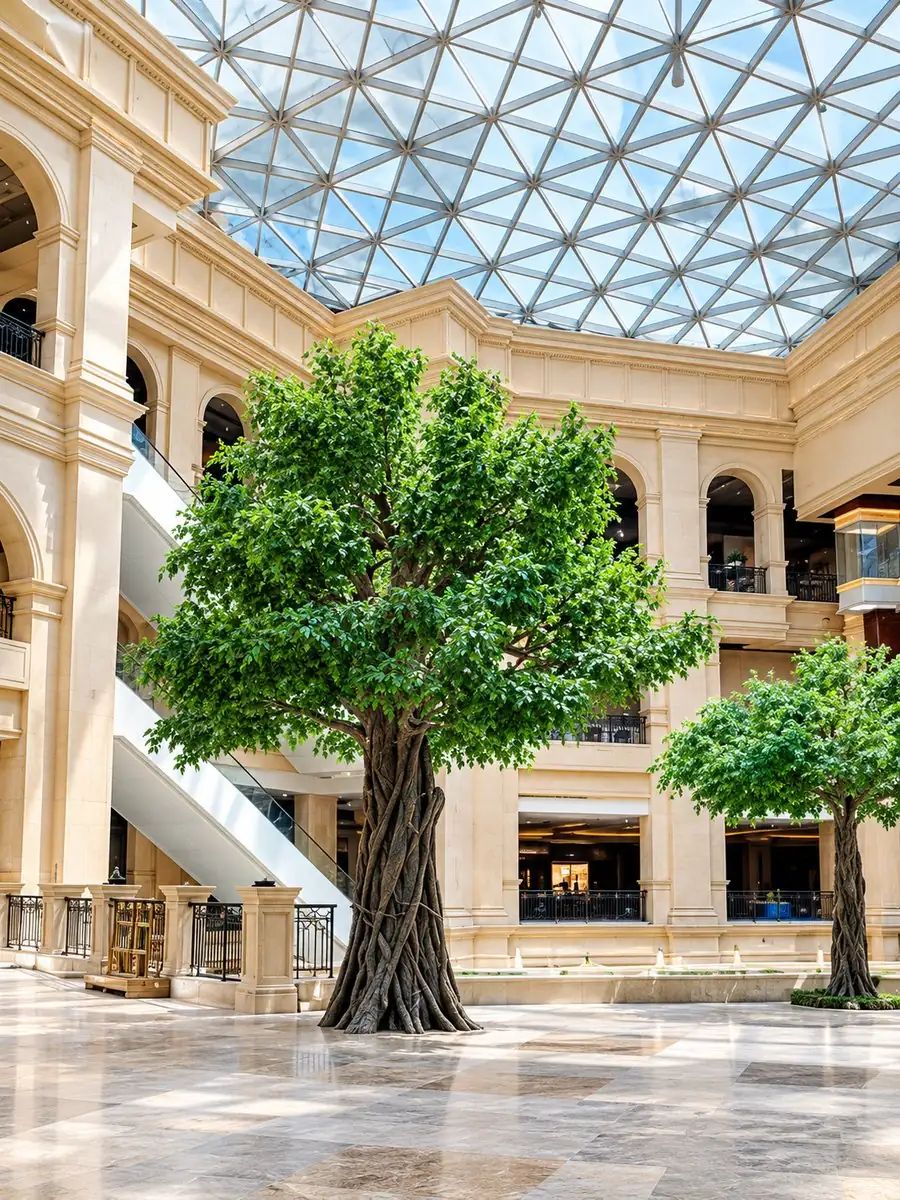
Where a property's hotel atrium differs in height or daylight from the group norm — a full-height glazed arrival versus a low lounge ceiling — the density and height change, but the frond material, coating and fire classification do not. That is the line to hold. A group that lets the material vary per property is no longer running a standard; it is running a purchasing habit.
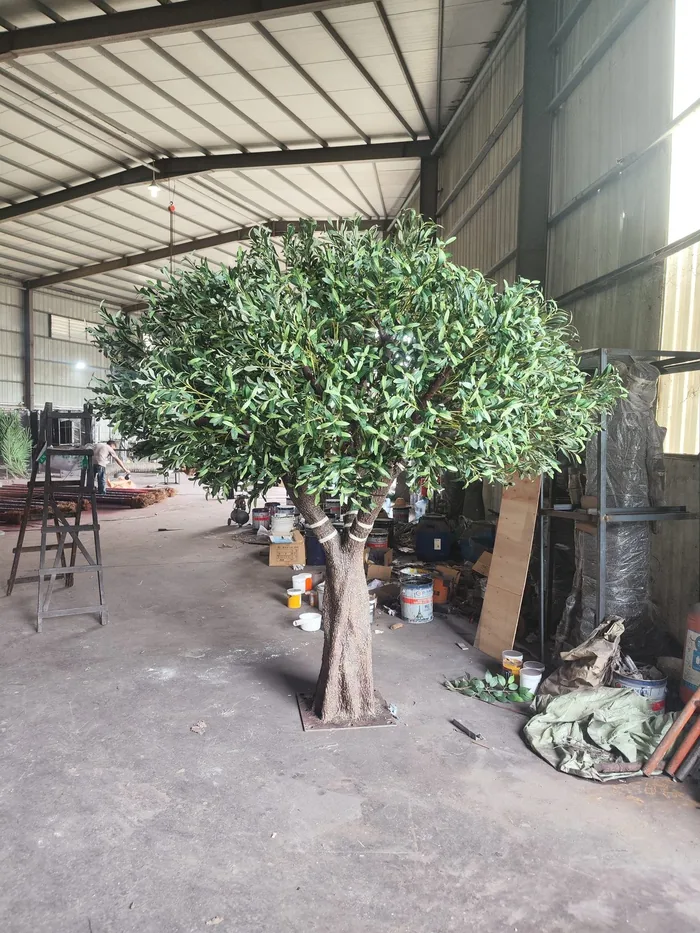
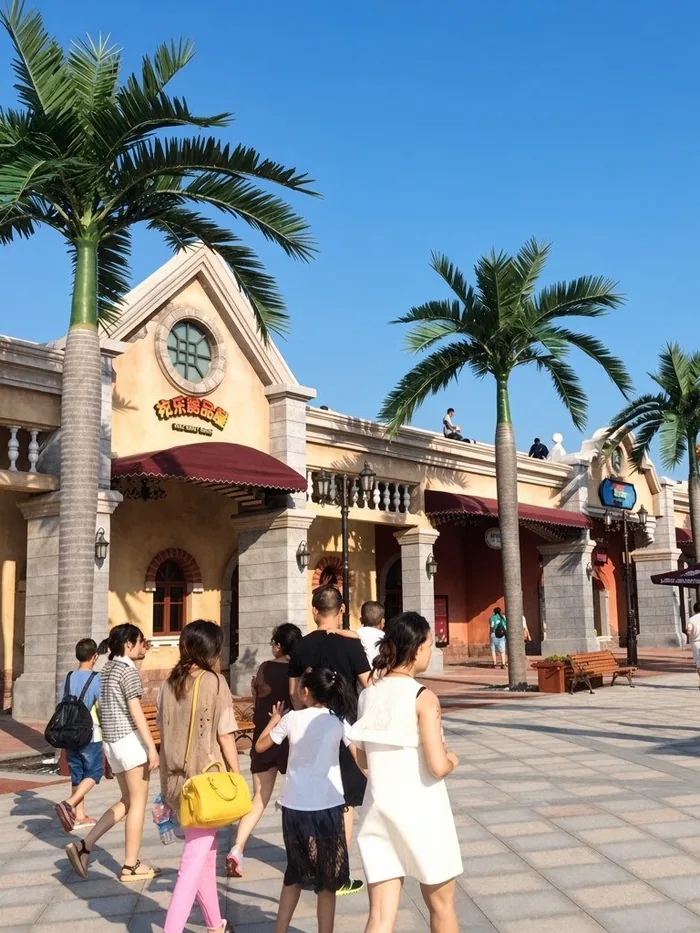
For groups mixing species, the same logic applies across the range: a date palm in a pool deck and an olive tree in a lobby can share one core specification and one colour protocol, even though they share no tooling.

5. Commercial Contractor FAQs
Q: How many tree models should a six-property group standardise on?
A: Four or five covers most portfolios once heights are grouped into bands of roughly 0.5 m rather than specified to the centimetre. The test is whether a position in the smallest property can be served by the same model as the equivalent position in the largest. If it can at a different height, it is one model, not two.
Q: Can a group hold one fire certificate across properties in different countries?
A: The classification can travel; the acceptance does not. A report to EN 13501-1 with the actual assembly named will be accepted by most consultants, but each jurisdiction may ask for a different submission format or an additional local approval. Plan one document set per property, drawn from the same test evidence, and confirm the batch reference on each shipment matches the report.
Q: What colour tolerance should be written into the contract?
A: ΔE 2.0 within a batch and 3.0 between batches, measured against a retained physical sample under a stated light source. Tighter than that is difficult to hold across a production programme of several phases; looser than that is visible when two specimens stand in the same sightline, which in hotel work they usually do.
Q: Is it cheaper to buy the whole programme in one shipment?
A: Freight per unit is lower, but the total is usually higher once storage, double handling and damage are counted. A working hotel has a small receiving dock and no secure storage for twelve crates of 6 m trees. Phased shipments cost more per container and less per programme, and they keep the installation team from competing with housekeeping for the service lift.
Q: How should a group handle a property that wants a different look?
A: Write it as an approved variant on the same substrate — a different planter finish, a different height, the same frond and core specification — and record it in the group spec as an option. That keeps the exception inside the document that governs procurement. An exception held in an email is the beginning of the drift the standard was meant to stop.
Project Engineering Support & CAD Requests
We work with hotel groups and their project managers at the programme level rather than property by property, which is what makes a phased rollout hold its specification. If you are assembling a group standard, send the position list, the property count and the structural conditions you already have for each building; we will return a base specification with the locked and variable columns separated, a per-property drawing schedule, and the sample and batch protocol we would apply across phases. Where a programme spans more than one country, we can also map the fire and customs documentation each destination will ask for before the first phase is quoted.
👉 Chat with Structural Engineering on WhatsApp (Instant Project Review)