Executive Summary
Most faux foliage damage is decided before the container leaves the yard. A 20–45 day voyage at 50–70 °C interior peaks, wire cores compressed beyond roughly 20 percent of their volume, single-wall cartons softening at high humidity, and timber trunks above 12 percent moisture content will between them produce flattened canopies, permanent bends and mould. Specify compression limits, five-ply cartons, desiccant at 50–100 g per cubic metre and a packed sample before production, and the arrival work drops to re-shaping rather than replacing.
The rest of this article is about the part buyers usually discover late: that "damage in transit" is not one failure mode but four, each with its own fix, its own cost and its own claim route. Treating them as a single quality complaint is why so many claims end with a discount instead of a replacement.
1. What Goes Wrong Without This
Start with water, because it is the failure that arrives silently. A steel container crossing the Gulf in summer heats to 50–70 °C by day and cools at night; the air inside cannot hold the same moisture at both temperatures, so it condenses on the ceiling and walls and drips onto the cargo. The industry calls it container rain, and the same mechanism inside a carton is cargo sweat. Industry estimates put moisture damage at roughly one containerised shipment in ten, and the damage is rarely dramatic — a swollen carton, a soft corner, a faint tide line on a trunk. What makes it expensive is that it is discovered at unstuffing, after the freight is paid and the installation date is fixed.
The second failure is compression, and it is the one buyers cause themselves by asking for volume. Wire-core branches recover from being bent; they do not recover from being held flat for five weeks under a stack of cartons. The workable limit is commonly 10–20 percent of stem volume, and past that the core takes a permanent set or snaps at the collar. The visible result is a canopy with flat panels that no amount of on-site dressing removes, sitting in a hotel atrium where the light rakes across it from a curtain wall.
The third failure is packaging collapse. Single-wall cartons absorb moisture and lose crush strength quickly; once a bottom carton gives way, the stack above it drops and the foliage underneath takes a point load it was never designed for. This is the failure that turns a well-packed pallet into a carton of scrap in a single handling step, and it usually happens in the last three days of the voyage rather than at the factory.
The fourth failure is biological. A timber trunk or a timber cradle that leaves the factory above about 12 percent moisture content is a substrate, not a material. White mould blooms in the dark and the humidity of a closed container, and it appears on the part of the tree the guest stands closest to. Removing it means sanding and re-finishing at destination, which changes the surface and never quite matches the rest of the batch.
The fifth failure is commercial rather than physical: an unclear damage protocol. When a canopy arrives deformed and nobody photographed the carton before opening it, the claim becomes a negotiation about whether the damage happened at sea or in the hotel loading bay. That negotiation is lost by default, because the evidence that would settle it — carton condition at unstuffing, photographed before the seal is cut — was never captured.
2. The Decision Framework
Seven checks decide whether a faux foliage shipment arrives usable. Each can be answered from a document or a sample before the deposit, which is the point: none of them require trusting a description.
1. Is compression designed into the packing, with a stated limit? Ask for the packed volume per unit and the ratio to the assembled volume. Anything beyond roughly 20 percent needs a written explanation of how the core is supported during the voyage, not just an assurance that it will be fine.
2. What is the carton specification, in plies and grade? Five-ply double-wall is the working minimum for sea freight; a flute grade and an edge-crush figure turn that from a claim into a specification. Single-wall cartons are acceptable for short-haul road freight and inappropriate for a 30-day ocean leg.
3. How is moisture controlled, at the material and at the carton? Timber components should be kiln-dried to 8–12 percent and declared; desiccant should be specified by weight per cubic metre of packed volume, not "some bags inside"; and foliage should not be sealed inside a closed poly bag, which traps the moisture it is supposed to shed.
4. Is the load path vertical or stacked? Heavy items — bases, ballast, planters — must never sit above a canopy. Where a mixed order needs the volume, the heavy lines go on the floor and the canopies ride on a deck above them, or the two ship as separate lines.
5. Are cartons kept clear of the container walls? Wall contact is where condensation collects first. A 100–150 mm clearance, held by dunnage or airbags, costs almost nothing and removes the single most common wet-damage location.
6. Has a packed sample been approved before the run? One packed carton, opened on video at the factory, is the most economical quality document in the order. It also settles the re-shaping argument later, because both parties have seen what "packed" was supposed to look like.
7. Is there a written damage protocol? Photographs of the container and cartons at unstuffing before any seal is cut, a claim window expressed in days from arrival, a named spare ratio, and a defined remedy — replacement, credit or local re-shaping labour. Without those four, the protocol is a conversation.
The seven checks scale with order size, which matters when a buyer is putting together a first container. For a single-model trial order of 5–10 units, checks 2, 3 and 6 carry almost all of the risk: the carton grade, the moisture control and one packed sample. For a mixed order of 30 units and up, checks 4, 5 and 7 become the expensive ones, because a stacking error or a missing claim protocol now affects a container rather than a carton. A phased hotel delivery adds an eighth consideration that is not on the list because it is not a packing question: storage. Cartons held on site for six weeks before installation meet the same humidity that caused the problem at sea, and a site store without dehumidification will undo a good packing job.

3. Numbers, Tiers and Timelines
The figures below are the working ranges used to write a packing specification. They are the numbers to put into a purchase order, because "protect the foliage" is not an instruction a packing line can execute.
| Item | Typical Range or Tier | What Drives It | Decision Rule |
|---|---|---|---|
| Voyage duration, China to Gulf port | 18–28 days port to port, 20–45 days door to door | Routing, transhipment, clearance | Plan moisture control for the door-to-door figure, not the sailing time |
| Container interior temperature swing | 25–35 °C night, 50–70 °C day peak in Gulf summer | Sun exposure, container colour, stow position | Assume condensation will occur on every leg; design for drainage and absorption |
| Safe stem compression | 10–20 % of stem volume | Wire diameter, branch collar welds | Above 20 %, require a supported packing drawing |
| Timber moisture content at packing | 8–12 % | Kiln drying schedule | Above 12 %, expect surface mould within a 30-day voyage |
| Desiccant dosing | 50–100 g per m³ of packed volume | Carton permeability, voyage length | Below 50 g/m³, moisture control is nominal |
| Carton grade for sea freight | 5-ply double wall, ECT declared | Stack height, humidity, handling count | Single wall only for road freight under 7 days |
| Re-shaping labour on arrival | 1.5–4 hours per large unit | Compression ratio, canopy density | Budget the hours into the installation programme, not the snagging list |
| Spare allocation for transit damage | 2–5 % of units per model | Fragility, handling count, route | Below 2 %, a single crushed unit becomes a schedule problem |
| Claim window after unstuffing | 3–7 days from container release | Local surveyor availability | Photograph at unstuffing; a claim opened after installation is usually refused |
Read the table as a budget rather than a checklist. The two lines that most often get skipped are the re-shaping hours and the spare allocation, and those are exactly the two that decide whether a damaged unit becomes a two-day delay or a two-week one.
4. How to Apply It to a Live Project
The framework has a specific place in each project stage, and applying it later costs more at every step.
At enquiry, ask for the packed volume per unit and the carton specification alongside the price. A supplier who cannot state packed cubic metres cannot quote freight honestly, and the number also tells you whether the canopy is being compressed sensibly or crushed to fit.
At sampling, request one packed carton rather than a bare sample tree. The bare sample proves the foliage; the packed carton proves the packing, and it is the only artefact that shows how the finished unit survives five weeks at sea.
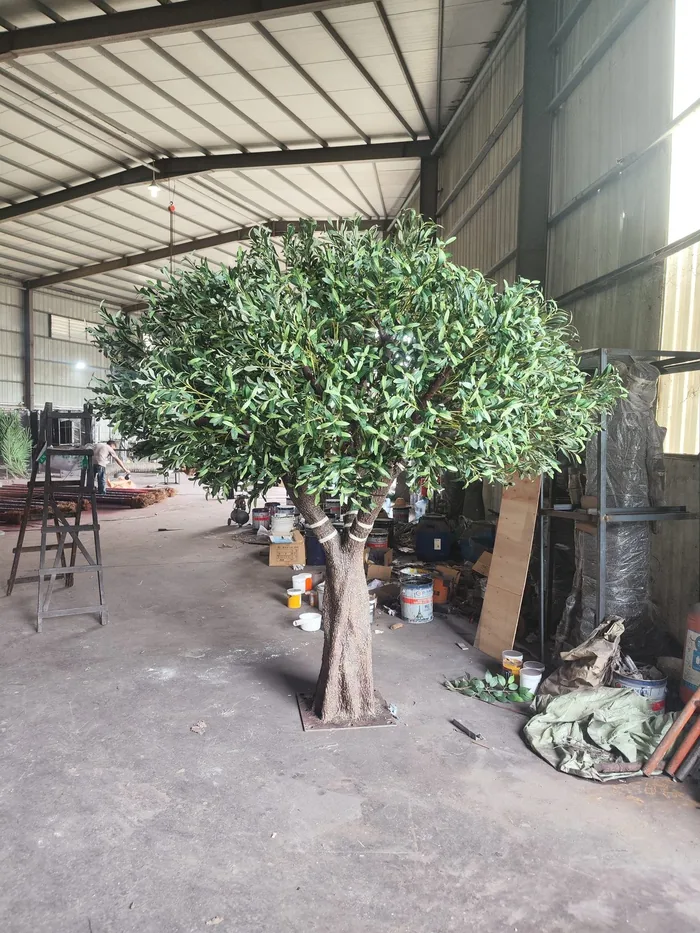
At drawing stage, get the packing drawing: carton dimensions, pallet or crate layout, stack height, and where the heavy lines sit relative to the canopies. This is also the moment to fix the base plate and cradle arrangement, because a 5 m olive tree that ships on a timber cradle arrives with its base protected and its canopy supported — a detail that pays for itself the first time a unit is re-sited.
During production, ask for two photographs: the packed carton closed and labelled, and the same carton opened. On a mixed order, this is also where the marking and barcode question gets settled, since cartons that will be cross-docked or stored before installation need labels that survive humidity.
At shipment, confirm wall clearance and decking in the loading plan, and take the stow photographs. For a project where date palm fronds and broadleaf canopies travel together, the fronds go high and light, the heavier units low, and nothing heavy above anything frangible.
On arrival, photograph before opening, then re-shape in a conditioned space rather than in the loading bay. Warm foliage held under load relaxes more predictably at 22–25 °C, and a unit re-shaped in the hotel atrium itself, after the floor is finished, is a unit that will be re-shaped twice.

5. Commercial Contractor FAQs
Q: Is desiccant enough on its own to prevent container rain?
A: No. Desiccant manages humidity inside the carton; container rain forms on the container's own surfaces and drips. The working combination is three layers: kiln-dried timber and dry goods at packing, desiccant at 50–100 g per cubic metre inside the carton, and cartons held 100–150 mm clear of the container walls so the condensation has somewhere else to go.
Q: How much canopy deformation is recoverable on site?
A: Flat-spotted PE foliage usually recovers most of its shape within 24–72 hours of release, given warmth and hand dressing. What does not recover is a wire core bent past its elastic limit — a branch that has taken a permanent set at the collar cannot be straightened without cracking the weld. The practical test at unstuffing is whether the branch springs back part way when released; if it stays where it is put, that is a claim, not a re-shaping job.
Q: Who pays for re-shaping labour, the factory or the buyer?
A: It depends entirely on what the purchase order says, which is why the protocol belongs in the order rather than in the correspondence. The common split is that routine re-shaping is the buyer's installation cost, while damage beyond an agreed threshold — crushed cartons, broken cores, mould — is the seller's. Fix the threshold in numbers, for example units requiring more than four hours of dressing, and the argument disappears.
Q: Does a compressed canopy get worse if the container sits in a port for a week?
A: Yes, and unevenly. Additional days at 60 °C under load increase the permanent set, and a container left in direct sun at a transhipment port is the worst case in the whole route. If a shipment is known to be transhipped, add desiccant, add spare units, and ask for the stow photographs — the marginal cost is small against the cost of a flattened canopy in a finished lobby.
Project Engineering Support & CAD Requests
We pack against a written specification rather than a house habit: packed cubic metres per model, carton grade, desiccant dose, cradle detail and the re-shaping allowance are all stated on the packing sheet that goes with the order. For a live project we can supply the packing drawing, a packed carton photograph set, and a marked loading plan that shows where the heavy lines sit relative to the canopies — the three documents that turn a damage argument into a routine inspection. Send the model list, heights and destination port, and our team will return the packed volume and the loading plan before you commit the container.
👉 Chat with Structural Engineering on WhatsApp (Instant Project Review)