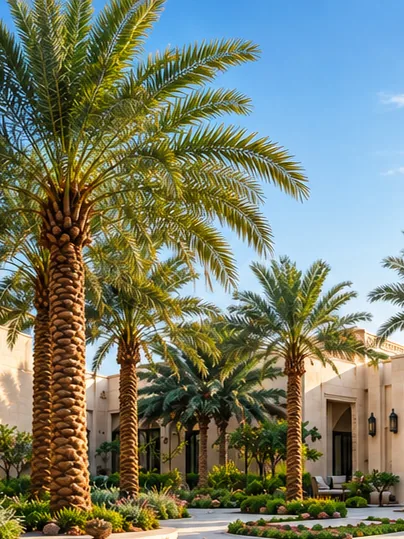
Executive Summary
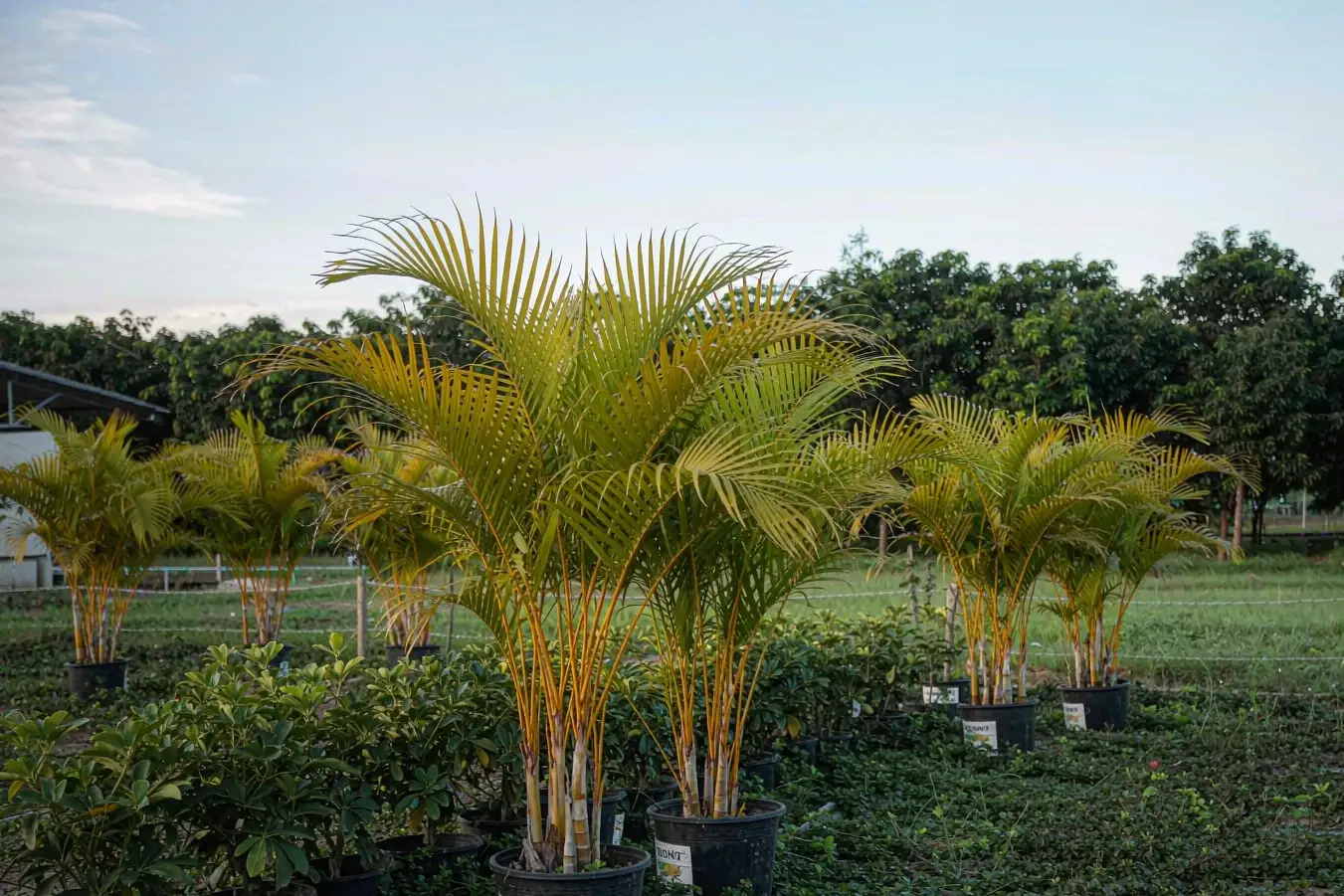
A large artificial areca palm that survives a Singapore building is built on a Q235 hot-dip galvanised core of Ø48–60 mm with a 3.5 mm wall and 85 µm minimum zinc to ISO 1461, a moulded fibreglass trunk shell rather than PU foam, and injection-moulded polyethylene fronds at 1,800–2,400 leaves/m³. At 80–90% relative humidity with chloride in the air, fabric foliage and foam trunks degrade before anything else. Flame performance must be inherent, not a topical coating the monsoon removes, and EN 13501-1 B-s1,d0 is the classification most consultants ask to see.
1. Failure Modes & Commercial Pitfalls
Singapore is not a heat problem. Mean daily temperature moves between roughly 24 °C and 31 °C, which is mild by Gulf standards. What punishes material specifications here is moisture that never leaves: relative humidity runs 80–90% most of the year, rainfall lands around 2,000–2,400 mm annually, and prevailing winds carry sea salt across an island roughly 50 km wide. A specification written for a Riyadh hotel atrium and reused in a Singapore lobby will fail on the second and third year, and it will fail in ways nobody photographed at handover.
Fabric foliage becomes a biological surface. Polyester and nylon weaves absorb moisture from the air, and at 85% RH they stay damp long enough for mildew to establish in the fibre. The visible sequence is dullness, then grey-black spotting along the leaf margins, then dye migration where a dark green bleeds into a lighter vein. A woven frond also takes on water weight during a downpour and collapses along the wire; it recovers partly, and each cycle leaves the crimp slightly worse. By year three the canopy reads thin from the atrium floor.
Foam trunks absorb, then deform. A PU foam trunk is cheap, light and convincingly textured under paint. Open-cell foam takes up ambient moisture, and in a mechanically cooled building it also collects condensate where the trunk meets a cold floor. Water uptake shows first as a softening at the base, then as a lean that cannot be corrected because the trunk has no structural member to straighten against. Once deformation sets in there is no site repair; the tree is replaced.
Topical flame retardants wash out. A surface-applied FR treatment can pass a test on the day it is applied and lose that performance after a wet season outdoors or after two rounds of cleaning indoors. The danger is documentary rather than physical: the compliance file still says the product meets the required class, while the delivered article no longer does. A re-inspection or an insurer's review eighteen months later is where this surfaces, and by then the batch is closed.
Zinc thickness is chosen for the wrong climate. An 85 µm hot-dip coating is generous in a dry inland city. On a coastal site classified C4 under ISO 9223, zinc is consumed at roughly 2.1–4.2 µm per year rather than the 0.7–2.1 µm of a C3 inland site. Thin coating plus a 304 stainless fastener in chloride air produces white rust at the base plate within the first wet season, followed by red rust at the thread.
Fronds are glued rather than mechanically fixed. Adhesive attachment is fast and invisible. Under monsoon wind load on a covered terrace, or under the airflow of a high-velocity air curtain at a hotel entrance, glued joints fatigue and shed. The result is a canopy that thins from the outside in, and a replacement-parts order that never quite matches the original colour batch.
The commercial pattern is consistent: the first two years look acceptable and the third year produces a replacement programme nobody budgeted for. The cost is not the tree. It is the access equipment, the out-of-hours installation in an operating lobby, and the mismatch between the replacement batch and the eleven units still standing.
2. Material Science & Structural Engineering Standards
The four components of a large palm have separate failure mechanisms in a humid climate, and each can be specified and then verified on delivery.
Foliage. Injection-moulded polyethylene absorbs less than 0.02% of its own weight in water, so humidity does not change its dimensions, its colour or its stiffness. The polymer needs a hindered amine light stabiliser package compounded into the resin rather than applied on the surface; HALS works by interrupting the photo-oxidation chain, which is why it belongs in the pellet and not in a spray. Colour stability under accelerated weathering should be reported against a measured colour difference, not an adjective: a ΔE of 3 or lower after 3,000 hours of ASTM D4329 cycle is a defensible figure for a commercial interior, and a supplier who cannot produce a delta-E reading is quoting an opinion. Woven fabric has no equivalent figure, because the failure mode is hydrolytic as well as photochemical.
Leaf density matters more in the tropics than in a dim interior. A palm specified at 1,800 leaves/m³ reads full in a photograph and thin against the bright, high-daylight glazing of a commercial atrium, because daylight transmits through a sparse canopy instead of being blocked by it. Commercial atrium work sits at 1,800–3,200 leaves/m³ depending on species and viewing distance, with areca and other pinnate palms toward the denser end because individual fronds are narrow.
Frond attachment should be stated as a method, not a claim. A mechanical fixing through a moulded collar on the rachis survives repeated flexing; an adhesive bond does not, and it fails silently from the inside of the joint where an inspection will not see it.
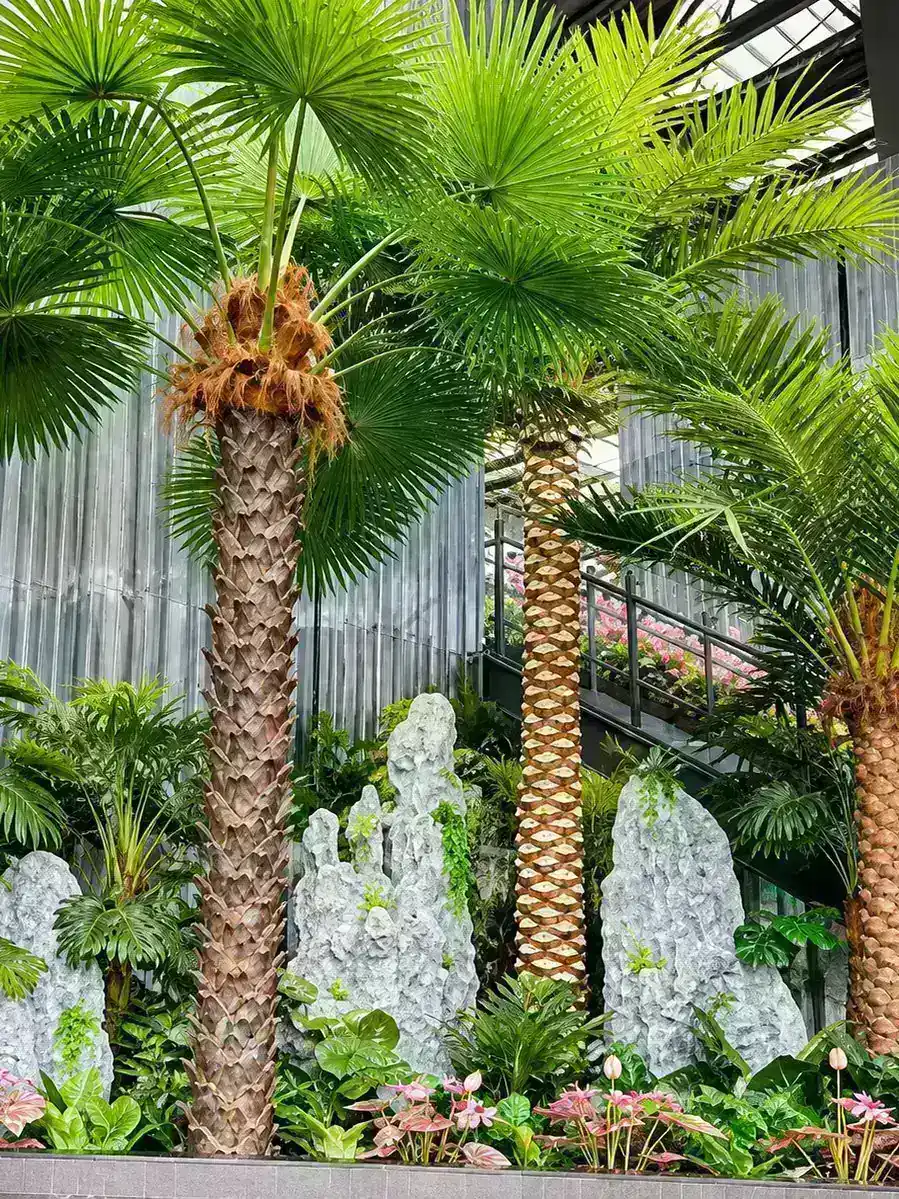
Trunk. A moulded fibreglass shell over the steel core holds a ringed texture with a hard edge, can be repaired by re-finishing a local area, and does not change dimension with humidity. Wall thickness for a 2.5–6 m palm runs 5–8 mm depending on diameter, laid up with a gelcoat that carries the pigment. Thin hand lay-up below about 4 mm crazes at the ring detail, and each craze is a path for moisture to reach the laminate, which then blisters from the inside. A foam trunk has no comparable structure at all; its only advantage is weight, and weight is the wrong thing to optimise in a 6 m object that has to stay straight for a decade.
Core. Q235 steel, hot-dip galvanised after fabrication so the coating covers the inside of the tube and the weld zone, at 85 µm minimum to ISO 1461, is the baseline for a commercial unit. Diameter scales with height; a 2.5 m palm does not need Ø76 mm, and paying for it is a legitimate place to save. What should not be traded is wall thickness at the splice, because a knock-down joint concentrates bending exactly where a 2.0 mm wall will ovalise first. Fasteners in chloride air should be A4/316 stainless, isolated from the zinc with a nylon washer where the detail allows, because a galvanic couple between dissimilar metals in a wet environment accelerates the attack on the less noble one.
Verification on delivery. Four checks carry most of the risk: a frond cross-section (solid moulded section versus woven fabric), a caliper reading on the core wall at the splice, a magnetic or elcometer coating thickness reading on the galvanised tube, and a colour comparison against a retained approved sample under the same light source. None requires a laboratory, and all four can be done on the loading bay before the container is unstuffed. The same checks apply to a date palm of comparable height, where the frond base differs but the core and coating questions do not.
3. Life Safety, Fire Codes & Environmental Compliance
Flame performance in a humid climate has one extra variable that dry-climate projects do not have to consider: water. A topical treatment is a coating, and coatings are consumed by rain, by condensation and by cleaning. Inherently flame-retardant formulations put the chemistry in the polymer or the fibre, so the performance does not depend on a surface that has to stay intact.
For a Singapore project the test evidence usually has to satisfy two audiences at once. The design consultant wants a classification to EN 13501-1, where B-s1,d0 is the common target for a large decorative item in a public atrium: limited contribution to fire, limited smoke, no burning droplets. The authority having jurisdiction may accept BS 476 Part 6 and Part 7 index data instead, depending on how the submission is framed. What matters practically is that the test report names the actual assembly — the frond as supplied, at the density supplied — rather than a resin sample, a fabric swatch or a generic "artificial foliage" description. A report for a material that is not the delivered material is the single most common defect in a fire dossier.
Smoke class deserves attention in a sealed building. A large canopy burns as a surface, and while the total fuel load of a decorative palm is small next to the building fabric, smoke production in a mechanically ventilated atrium without openable façade is what triggers evacuation rather than the flame itself. s1 versus s2 is therefore not a formality.
Indoor air quality is the other compliance thread. Low-VOC polymers and a cured, odour-free finish matter in a building that recirculates air; solvent smell from a freshly unpacked tree is a real complaint in a hotel lobby, and it is a finishing issue, not a material one. Cured fibreglass with a properly specified gelcoat is inert once outgassed. Foam, by contrast, can hold process residues and odour for weeks, and in a humid environment it holds moisture with them.
For export documentation, the same file should travel with the goods: classification report, the batch reference it applies to, and the material description that matches the invoice. When the three do not match, the problem appears at customs or at handover, not at the factory.
4. Technical Comparison Table
| Tree Height (m) | Min Core Steel Ø (mm) | Leaf Density (leaves/m³) | Floor Live Load & Ballast (kg) | Application | Indoor/Outdoor |
|---|---|---|---|---|---|
| 2.5–3.0 | 48 | 1,800–2,000 | 45–70 | Corporate HQ reception planter | Indoor |
| 3.5–4.0 | 48–60 | 2,000–2,400 | 70–110 | Airport VIP lounge | Indoor |
| 5.0–6.0 | 60–76 | 2,200–2,600 | 110–180 | 5-star hotel atrium | Indoor |
| 7.0–8.0 | 76 | 2,400–2,800 | 180–280 | Mall atrium | Indoor |
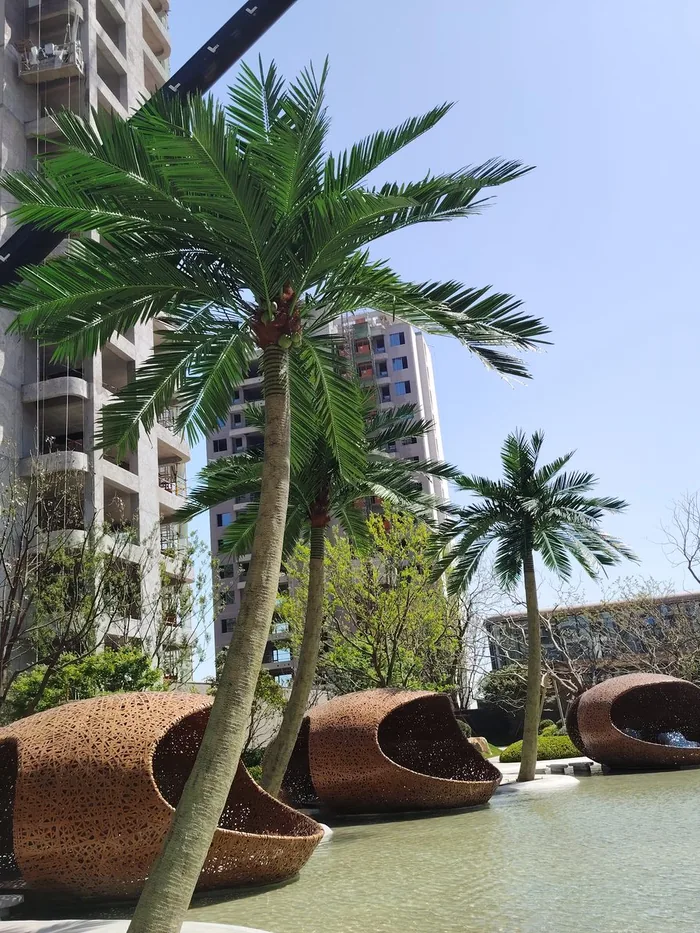
| 6.0–8.0 | 76 | 2,600–3,200 | 280–420 + base plate | Seaside resort terrace | Outdoor |
The ballast column assumes a ballast-collar planter on a raised floor or a finished slab. Where the tree is bolted to structure, the governing number is not mass but the uplift and overturning moment at the base plate, and that calculation belongs to the project engineer rather than the supplier.
5. Structural Anchoring & MEP Coordination
Two fixing strategies cover most Singapore installations. A ballast collar planter carries the tree on its own mass, needs no penetration, and suits finished stone or a raised access floor in a tenancy the owner will not allow to be drilled. A bolted base plate transfers load into the slab and is the correct choice for anything above about 6 m, for outdoor terraces with wind exposure, and anywhere the tree stands in a circulation route where a lean would be a hazard.
In a humid building the anchoring detail has a second job: drainage. Condensate forms on cold metal and runs down the core; if the planter is sealed, water sits at the base plate and the coating fails from the bottom up. A drained planter with a removable inspection cover costs little at order stage and is close to impossible to retrofit once the tree is dressed and the surrounding floor is finished.
Coordination items that regularly cost a week on site:
- Sprinkler clearance. A canopy directly under a sprinkler head blocks the spray pattern. The layout either moves the head or the tree reduces in height; deciding this after the ceiling grid is set means a change order.
- Air curtain velocity. A high-velocity entrance curtain at 2.5–3.5 m/s applies a continuous lateral load at canopy height. For a 5 m palm within 2 m of the door line, that load belongs in the base plate sizing, not in a verbal assurance.
- Air-conditioning diffusers. A diffuser discharging directly onto a canopy drives dust into the fronds and, in a cooled space, keeps the surface at dew point. Both accelerate the cleaning cycle.
- Maintenance access. A 6 m palm in an atrium needs a cleaning route. If the only access is a scissor lift booked through the mall's night shift, the cleaning frequency in the maintenance manual is fiction.
Where the base geometry is non-standard — a curved planter, a structural plinth, a roof deck with a waterproofing membrane that cannot be penetrated — the fixing detail has to be drawn as a custom anchor rather than selected from a catalogue, and the drawing has to show the waterproofing build-up, not just the plate.
6. Commercial Contractor FAQs
Q: Does PE foliage really outperform silk in a Singapore interior, or is that a supplier talking point?
A: It is measurable. Extrusion-grade PE absorbs under 0.02% water by weight, so humidity does not swell it, and a HALS package compounded into the resin holds colour without a surface coating to renew. Woven polyester absorbs moisture, supports mildew growth at sustained 85% RH, and loses tensile strength as the fibre hydrolyses. In an air-conditioned interior with a glazed façade, PE at 1,800–2,400 leaves/m³ is the specification that still looks correct in year five.
Q: The consultant specifies EN 13501-1 B-s1,d0. What has to be in the submission file?
A: A test report naming the actual frond assembly at the supplied density, the classification document that follows from it, and a batch reference linking the report to the production run being shipped. Reports that describe a resin, a fabric swatch or generic "artificial foliage" are rejected on review because they do not describe the article in the atrium.
Q: How much zinc coating is enough for a coastal site?
A: 85 µm minimum to ISO 1461 on a hot-dip galvanised core, with the coating applied after fabrication so welds and tube interiors are covered. On a C4 coastal classification, zinc consumption runs 2.1–4.2 µm per year, which gives a calculable service window rather than an open-ended claim. Below about 55 µm, the base plate is the first place white rust appears.
Q: Can a knock-down palm be assembled on site without losing straightness?
A: Yes, if the joint is a machined sleeve with a mechanical stop rather than a butt weld made on site. The sleeve holds alignment, the splice carries the bending, and the assembly check is a plumb reading at the crown after tightening. A site-welded joint in a finished lobby is both a fire-permit problem and a straightness problem.
Project Engineering Support & CAD Requests
We build these palms to a project drawing rather than a catalogue photo, which is why the specification conversation is worth having before the ceiling grid is fixed. If you are comparing submissions for a Singapore or wider Southeast Asian project, send the intended location, height, fixing condition and the classification your consultant requires, and we will return a shop drawing set, a frond and trunk finish sample, and the test documentation that matches the batch you would receive. Our engineering team can also review a consultant's specification against what is actually buildable at the height and density being asked for.
👉 Chat with Structural Engineering on WhatsApp (Instant Project Review)