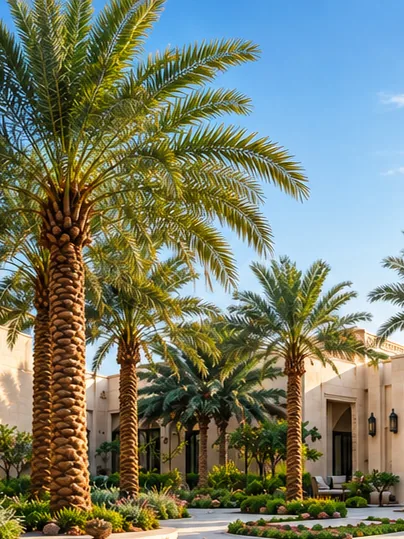
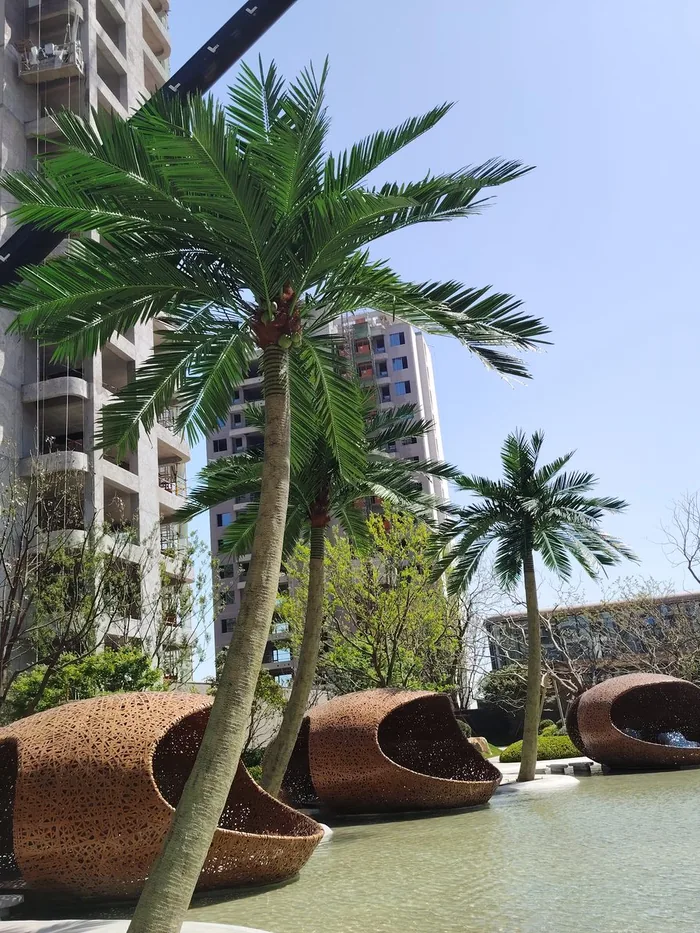
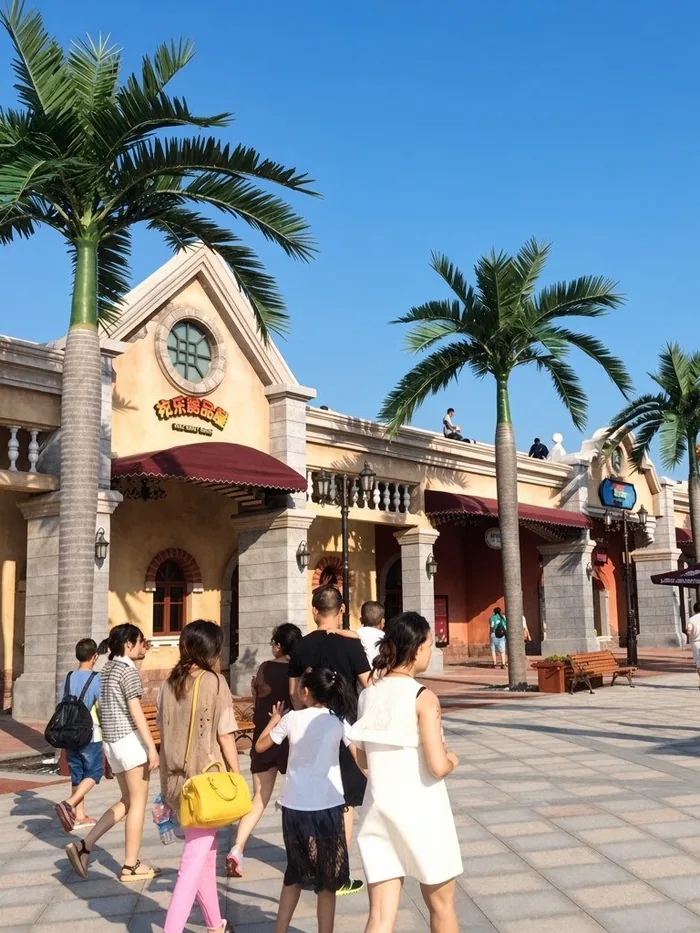
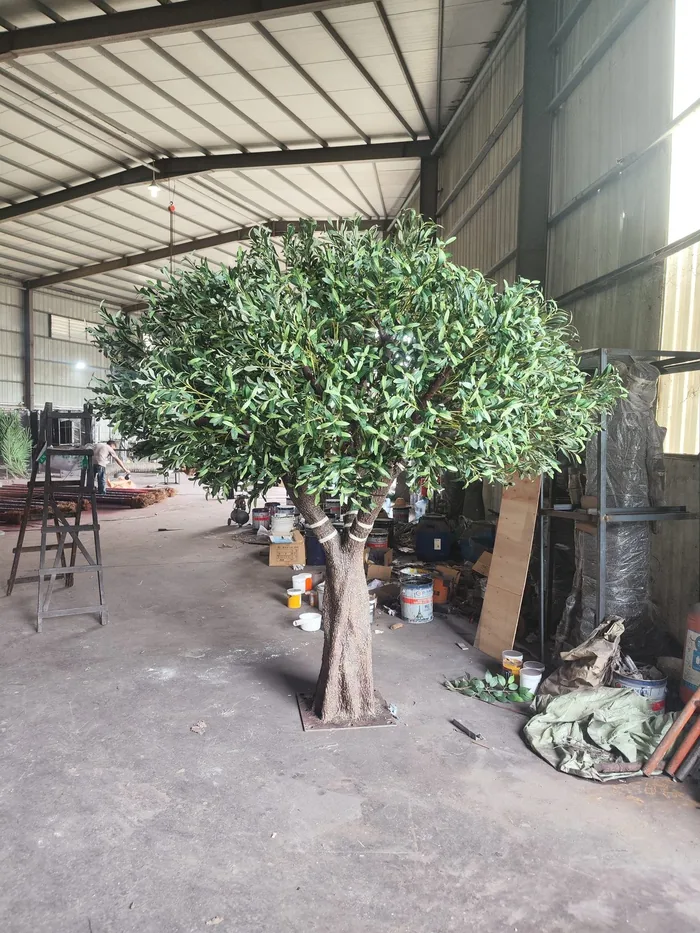
An outdoor artificial palm on a Gulf coastal site should hold colour to Grey Scale 4 (ISO 105-A02) and ΔE ≤ 3 (ASTM D2244) after 1,500–2,000 h of ASTM G154 UVA-340 exposure, mounted on a Ø48–76 mm Q235 hot-dip galvanized core with a 2.5–3.2 mm wall and 1,800–3,200 leaves/m³ of UV-stabilised injection-moulded PE foliage, IFR to NFPA 701 available as an option. Specified below that line — topical UV spray, silk fronds, recycled regrind with a degraded stabiliser package — the documented failure window at 45–50 °C is two to four summers, and the fix is a crown replacement rather than a repair.
Key Takeaways
- Acceptance line for Gulf coastal work: Grey Scale 4 (ISO 105-A02) and ΔE ≤ 3 (ASTM D2244) after 1,500–2,000 h of ASTM G154 UVA-340 exposure, evaluated on a production-moulded leaf in the specified colour — never converted from lab hours into outdoor years.
- UV50+ means stabiliser compounded in-resin: HALS at 0.3–0.8% working with a UV absorber; a topical spray film is typically spent before the first annual maintenance visit in a high-UV zone.
- Structural frame behind the foliage: Q235 hot-dip galvanized core at Ø48–76 mm with 2.5–3.2 mm wall, AWS D1.1 welds, ISO 1461 galvanizing (85 µm minimum average coating on steel over 6 mm); C5-M sites corrode unprotected carbon steel faster than 50 µm per year.
- Coastal fixing evidence: ISO 9227 or ASTM B117 salt spray at 480–720 h on the base plate, bolts and any exposed steel.
- A warranty is only worth its paper when it names covered SKUs, installation environment, a measurable fade limit, exclusions, remedy and freight responsibility — market warranties run from five years on qualifying panels to twelve months on individual trees, several excluding colour change altogether.
Six Specification Errors Behind Early Yellowing
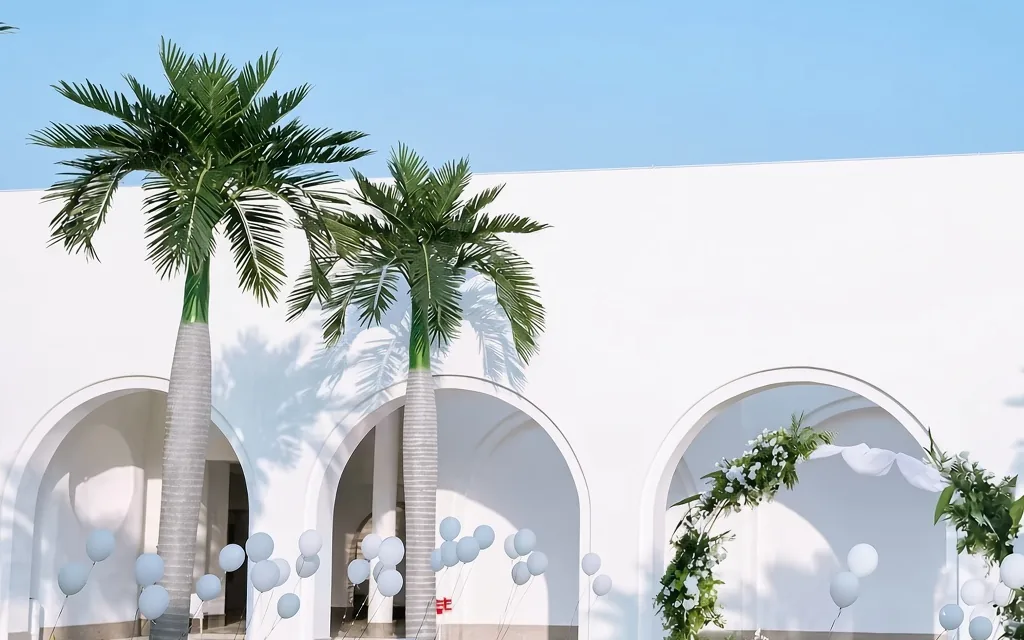
Artificial foliage does not fail the way buyers expect. It does not tear or collapse; it loses colour first — unevenly, starting at the sun-facing face of the crown — and by the time the shift is obvious in a smartphone photo it has been on site for a full season. Six specification errors produce almost all of it.
Topical UV protection quoted as UV50+. A surface spray carrying the UV absorber, rather than the polymer itself, is the lowest-cost way to answer a UV question in a quotation, and its protection window in a high-UV zone is measured in months. Chalking and dulling follow on the exposed face, then a drift of pale pigments toward grey-green; the remedy is a crown replacement across the affected elevation, not a touch-up.
Silk or polyester fronds on outdoor work. Polyester hydrolyses under combined UV and moisture, the fibres mat, and matting removes the porosity that lets air pass through a crown. A colour problem quietly becomes a structural one: the crown presents more solid area in year three, and the projected area feeding the drag equation has changed without anyone reissuing the anchor detail.
Test evidence for a different product. A UV report is evidence only when it describes what is being bought: same polymer grade, stabiliser package and colour, and a production-moulded leaf rather than a flat plaque. Reports issued without irradiance, chamber cycle, duration and evaluation method are not reviewable, and a 1,000 h figure is a comparison between two formulations under one cycle — not a service-life statement. Reject any conversion from lab hours to outdoor years in writing, before the quotation stage.
No retained colour baseline. Without an unexposed retained sample and an agreed measurement — ΔE to ASTM D2244 or a grey-scale rating to ISO 105-A02 — nobody can prove fading, because nobody defined it. Fronds ordered in year three also arrive from a different batch, and the mismatch is visible under façade lighting long before it is visible in daylight.
Heat treated as the same mechanism as light. Radiant load from a pale façade plus 45–50 °C ambient pushes surface temperatures well above air temperature on dark components. Plasticiser migration, gloss loss and chalking follow, accelerating in PVC formulations rated only "moderate" outdoors; recycled regrind behaves worse because its stabiliser package was partly consumed in its previous life.
A warranty that does not define fading. A five-year label frequently covers cracking and structural failure while excluding colour change and weather. Unless the document names covered SKUs, environment, a measurable fade limit, exclusions, remedy and freight responsibility, the venue owner will read "excessive fading" in year two and the supplier will answer with "normal ageing".
Material Science: Resin, Pigment and Structure
Weathering performance is decided at the resin stage. UV stabilisation in commercial outdoor builds means HALS compounded into the masterbatch at 0.3–0.8%, working with a UV absorber: HALS scavenges radicals and protects the polymer chain, the absorber converts UV into heat before it reaches the pigment system. Neither can be sprayed on afterwards with the same effect — "UV treated" and "UV50+ in-resin" are not interchangeable and should never be one category in a bill of quantities.
Pigment chemistry decides how visible degradation becomes: earth tones built on inorganic pigments hold their reading far longer than bright organic yellows and greens, and lighter tones lose contrast against a façade first because there is less chroma to lose before the leaf reads grey. Moulded PE fronds with a 1.2–2.0 mm wall keep their angle and surface finish, while thin extruded fabric flattens and mats. Crown density for commercial work runs 1,800–3,200 leaves/m³ — dense enough to read as a crown from three floors up without closing the canopy into a solid sail.
The structural frame makes the foliage specification meaningful: a Q235 core of Ø48–76 mm with a 2.5–3.2 mm wall, welded to AWS D1.1 and hot-dip galvanized to ISO 1461, where the minimum average coating on steel over 6 mm is 85 µm. Coastal and rooftop locations fall into ISO 12944 category C5-M, where unprotected carbon steel corrodes faster than 50 µm per year — the reason core, base plate and fixing hardware are specified together. A 4 m courtyard specimen sits at Ø48–60 mm, a 9 m date palm at the Ø76 mm end.
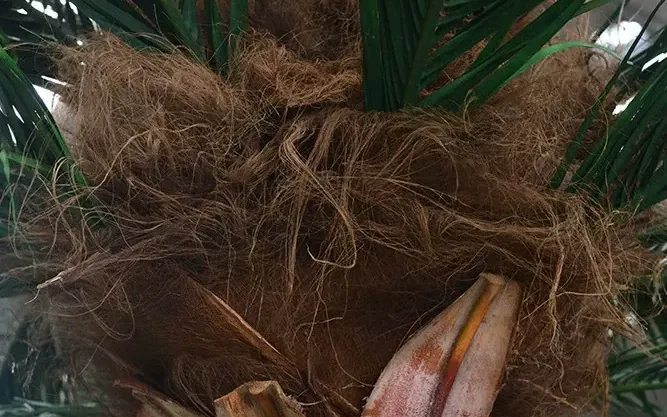
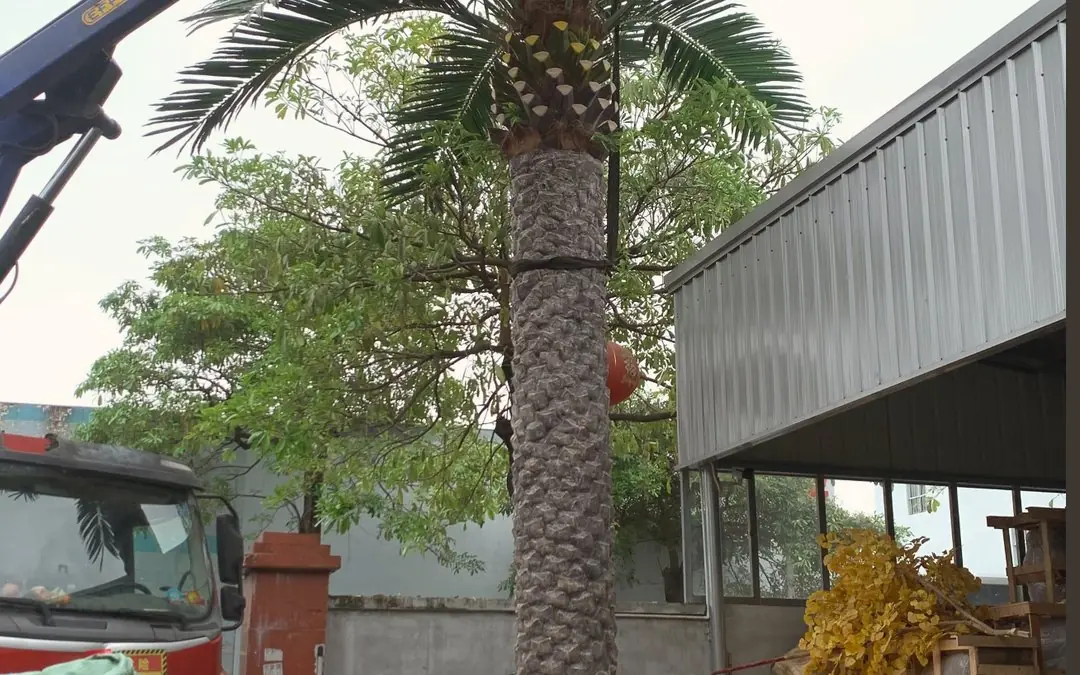
The trunk shell carries its own weathering case: centrifugally cast fiberglass reproduces bark and ring texture and needs a UV-stabilised gelcoat to hold gloss, while synthetic foam trunks chalk, discolour and crush locally where the core passes through. The fibrous crown wrap that hides the core junction is a common weak point in cheap builds — loose, unbacked fibre mats hold water and read as shaggy within two seasons — so in a commercial build it has to be bonded and trimmed as a defined component.
The Test Protocol to Write Into the Specification
What to ask for at specification stage is a defined test protocol, not a certificate number. A workable requirement set reads:
- Chamber exposure: ASTM G154 or ISO 4892-3, UVA-340 lamps, a stated cycle (for example 8 h light at 60 °C / 4 h condensation at 50 °C), stated irradiance at 340 nm, and a stated duration of 1,500–2,000 h for Gulf coastal work.
- Evaluation: colour difference to ASTM D2244 (ΔE) plus a grey-scale rating to ISO 105-A02, and a stated visual check for chalking, crazing and cracking on the same specimen.
- Specimen identity: finished moulded leaf or production crown section, in the actual specified colour, from the actual production line.
- Salt spray: ISO 9227 or ASTM B117, 480–720 h, on the base plate, bolts and any exposed steel.
- Trunk and finish: gelcoat or coating details with dry-film thickness, and adhesion tested by pull-off to ISO 4624 where a coated system is used.
Fire and Environmental Documentation at 50 °C
Outdoor foliage passes through two approval lines, and UV evidence answers only one of them. NFPA 701 is the North American baseline for flame spread on textiles and films — Method 1 for small-scale screening, Method 2 for large assemblies — and EN 13501-1 Class B-s1,d0 is what EU-tendered work and most GCC hospitality packages request, with documentation issued per order to the standard the project specifies. IFR builds carry the additive in the resin so the rating travels with the material for the life of the part; topical flame retardant depends on a film that UV exposure, cleaning and abrasion are all working to remove.
The two files should be read together, because they are affected by the same additives: UV stabilisers, pigments and fire retardants are formulated into one compound, and a supplier optimising only for flame spread can deliver a crown that discolours in a season. Confirm that the IFR package and the stabiliser package belong to the same formulation revision — a mid-project compound change invalidates both reports — and where the authority reviews a weathered façade element, the IFR formulation can be specified for testing after the agreed weathering cycle rather than as-new.
For enclosed hotel atrium installations, a recirculating HVAC system moves whatever the polymer off-gasses, so a REACH-conformant PE with no added plasticiser is the normal specification, with the material declaration naming the polymer and additive families. A submittal that lists formulation, colour, code year, weathering hours and evaluation method in one table is checkable; a folder of certificates with no product reference is not.
Specification Table by Species and Exposure
| Tree Height (m) | Min Core Steel Ø (mm) | Leaf Density (leaves/m³) | Floor Live Load & Ballast (kg) | UV / Weathering Evidence to Demand | Application | Indoor/Outdoor |
|---|---|---|---|---|---|---|
| Olive 2–6 | 48–60 | 1,800–3,200 | 100–220 anchored | G154 1,500–2,000 h, ΔE ≤ 3, GS 4 | 5-star hotel atrium / shaded terrace | Indoor, UV add-on for terraces |
| Coconut Palm 3–7 | 48–60 | 1,800–3,200 | 140–280 | G154 2,000 h plus B117 480 h | seaside resort pool deck | Outdoor (UV50+) |
| King Palm 4–8 | 60–76 | 1,800–3,200 | 180–320 | G154 1,500 h, ΔE ≤ 3, GS 4 | mall atrium / airport VIP lounge | Indoor / Outdoor |
| Washingtonia Fan Palm 4–8 | 60–76 | 1,800–3,200 | 160–300 | G154 2,000 h plus B117 720 h | hotel porte-cochère / city streetscape | Outdoor (coastal) |
| Date Palm 4–9 | 60–76 | 1,800–3,200 | 150–300 | G154 2,000 h, salt spray 720 h, ΔE ≤ 3 | seaside resort courtyard / public realm | Outdoor (C5-M) |
| Banyan 4–10 | 60–76 | 1,800–3,200 | 250–450 | G154 1,500 h, visual cracking check | corporate HQ reception | Indoor |
| Atrium Ficus 6–12 | 76 | 1,800–3,200 | 300–500 | indoor case: none required, low-VOC declaration | mall atrium / transport hub | Indoor |
Read the last two columns first. A commercial atrium case is governed by cleaning impact, seismic restraint and air quality, so the money belongs in the core and the anchor; move the same species outdoors and the exposure column becomes the governing purchase criterion. The same 4 m olive tree can legitimately be specified with two different foliage builds on one project — the mistake to avoid is a single line item labelled "UV treated" covering both.
Base, Salt Spray and Maintenance
The base is where a coastal specification fails first, and it usually fails before the foliage does. Hot-dip galvanizing to ISO 1461 or A4 stainless fasteners are the baseline within salt-spray reach; bright zinc-plated bolts in a C5-M environment are gone in a couple of seasons, and the visible symptom is rust staining on the pavers, not a detached tree. Because the anchor detail is small, it is also the item most often deleted from a value-engineered package — and the one item that cannot be replaced after handover without scaffolding and a slab repair.
Thermal movement needs to be designed in: exposed steel in Gulf conditions is normally detailed for a 25 °C differential, so the base plate needs slotted holes or expansion washers to move without preloading the anchors. On a rooftop terrace, the spreader plate sits above the waterproofing membrane on a protected upstand and the anchor uplift is resolved against the roof framing, not the screed. Where drilling is prohibited — a warranted deck, a post-tensioned slab, a finished stone floor — a ballasted collar planter is the alternative: water-filled ballast loses mass to evaporation, foam ballast degrades at 50 °C, and sand or concrete ballast must be accounted for as a permanent floor load.
Maintenance closes the loop. High-pressure washing abrades the stabiliser-bearing surface layer and shortens colour life; solvent cleaners attack pigment and gelcoat. A pH-neutral cleaner, a soft brush and a defined annual inspection — crown colour against the retained sample, base plate condition, bolt torque, ballast mass, planter shell — keeps the evidence chain alive for a warranty claim. MEP adds two site conditions: entrance air curtains impose a repeated 2–5 m/s load on anything in the door line, a fatigue case rather than an overturning one, and sprinkler throw clearance fixes the crown height in a covered atrium before the tree order is placed.
FAQ
How many hours of ASTM G154 should a 50 °C desert project require?
For exposed Gulf coastal and desert installations, specify 1,500–2,000 h to ASTM G154 with UVA-340 lamps and a stated cycle, evaluated as ΔE ≤ 3 (ASTM D2244) with a grey-scale rating of 4 or better (ISO 105-A02) on a production-moulded leaf in the specified colour. Do not accept a conversion from hours to years: chamber conditions change results, and accelerated data is comparative between formulations rather than predictive of service life. Ask for the same test run on the candidate products and read the numbers side by side.
The supplier offers a five-year UV warranty — what has to be written into it to be worth anything?
Covered SKUs and quantities, the installation environment (full sun, sheltered, coastal), a measurable fade limit, the listed exclusions, the remedy (repair, replacement or credit), whether it is prorated year by year, who pays freight and duties, the claim deadline and the evidence required. Market warranties run from five years on qualifying panels down to twelve months on individual trees, and several exclude weather damage and colour change altogether — the period alone tells a buyer nothing.
Why do light-coloured fronds fail earlier than dark green ones?
Light tones lose contrast sooner because there is less chroma to lose before the leaf reads grey, and organic yellow pigments shift faster than inorganic earth tones. For a pale scheme, specify the pigment family rather than a colour reference, raise the stabiliser loading within the compound, and hold a retained unexposed sample as the contractual baseline. On a two-tone façade, buy the full replacement quantity for the exposed elevation in one production batch.
Can UV-treated and standard foliage be mixed on one project?
Only per exposure zone, and only when the zones are genuinely different — a sheltered arcade, a shaded courtyard and a west-facing forecourt are three different cases, but each line item must state its own hours and acceptance limit. For replacement, keep the retained sample, record the batch code on the packing list, and order replacement crowns or foliage modules rather than individual leaves, so colour and geometry stay consistent without re-rigging the tree on site.
References and Authoritative Sources
Standard Practice for Operating Fluorescent Ultraviolet (UV) Lamp Apparatus for Exposure of Nonmetallic Materials
>
— ASTM International, ASTM G154. Official page
"This standard establishes test methods to assess the propagation of flame of various textiles and films under specified fire test conditions."
>
— NFPA, NFPA 701: Standard Methods of Fire Tests for Flame Propagation of Textiles and Films. Official page
Project Engineering Support
Our engineering team issues weathering and salt-spray documentation against a named formulation and colour, together with the anchor calculation and finish swatches, so a structural engineer and a QHSE reviewer work from one submittal. The full range is listed in the product catalogue, and project-specific builds start from the same formulation data. Send the site location, the exposure direction and the species list, and we return the specification sheet with the UV and fixing evidence already mapped to each tree position.
👉 Chat with Structural Engineering on WhatsApp (Instant Project Review)