Executive Summary
A potted olive tree is two purchased items: a 2–6 m tree on a galvanized steel core, and a moulded planter with its own MOQ, carton and cubic metres. Budget roughly 14 trees of 5 m per 40HQ including planters, foliage to NFPA 701 Method 1 or EN 13501-1 B-s1,d0, and 120–260 kg of ballast per unit where the planter carries the anchoring duty.
That split is the whole problem in one sentence. Buyers who treat the pot as packaging discover at quotation stage that it is a separate production line with a separate minimum, a separate carton size and a separate damage profile. The tree model can clear its minimum and the order still stalls, because the planter finish chosen for the lobby exists in a mould that only runs at a different quantity. Consolidation is possible, but it has to be designed into the order rather than negotiated after the deposit.
1. Failure Modes & Commercial Pitfalls
The first failure is arithmetic, not manufacturing. A specification that reads "olive tree, 4 m, white planter" looks like one line item. In production it becomes a tree SKU with a height band, a foliage finish and a base configuration, plus a planter SKU with a mould, a colour and a ballast option. Two SKUs, two minimums, two cartons, two freight profiles. When the buyer assumes one minimum covers both, the quotation comes back split and the project loses two weeks to re-scoping.
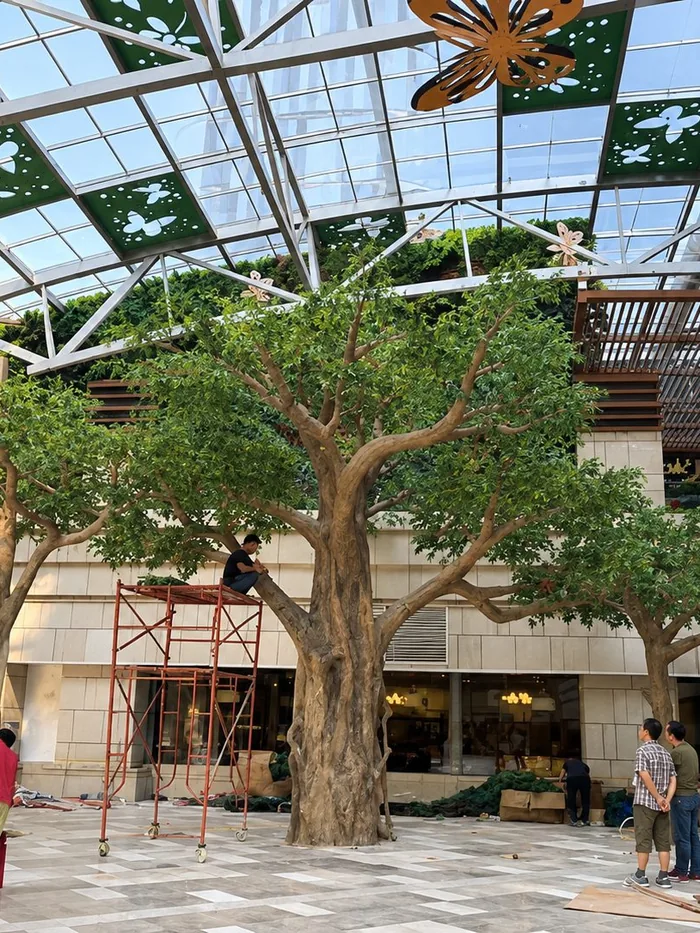
The second failure is paying freight on air. A planter sized for a 5 m specimen encloses 0.30–0.55 m³ of nothing. That void is billed like cargo. On a mixed order of 40 potted units, empty planter volume can reach 12–18 m³ — close to a fifth of a 40HQ — and it earns nothing. The fix is not to shrink the planter until the tree looks top-heavy; it is to nest planters, pack them as a separate line, or ship soils-free planters flat where the mould allows it. Whichever route is chosen has to be decided before the packing list is written, because it changes the carton count and the loading plan. The same arithmetic shows up in mall landscaping orders, where 60–80 potted units across four heights are ordinary and the empty volume is the difference between one container and two.
The third failure is a planter that cannot hold the tree. A hollow rotomoulded shell with a plywood or steel plate insert is stable only while the insert is bolted down. Where the planter is expected to resist a lean — a hotel atrium with trolley traffic, a terrace with crosswind — the ballast has to be inside the shell, and the shell has to be rated for that load. Buyers regularly discover this on site, after the podium floor has been finished, when the installer says the pot needs 200 kg of sand that nobody ordered.
The fourth failure is moisture. A sealed planter cavity crossing 20–45 days of ocean freight collects condensate. Mould on a fibre-glass interior is not visible from the lobby, but it is visible to a snagging inspector with a torch, and it is a rejection item on hospitality handover. Venting, desiccant in the cavity, and a drain detail that is capped for transit and opened at installation cost almost nothing at order stage and a great deal afterwards.
The fifth failure is colour drift between batches. Planter finishes are pigment-matched by batch, not by photograph. When half the planters ship with the tree order and the balance arrives three weeks later from a second run, the whites differ under 3000 K lobby lighting even when both are "white". For phased hotel deliveries, the finish reference has to be a physical sample held by both parties, and the balance of the order has to be produced against it.
2. Material Science & Structural Engineering Standards
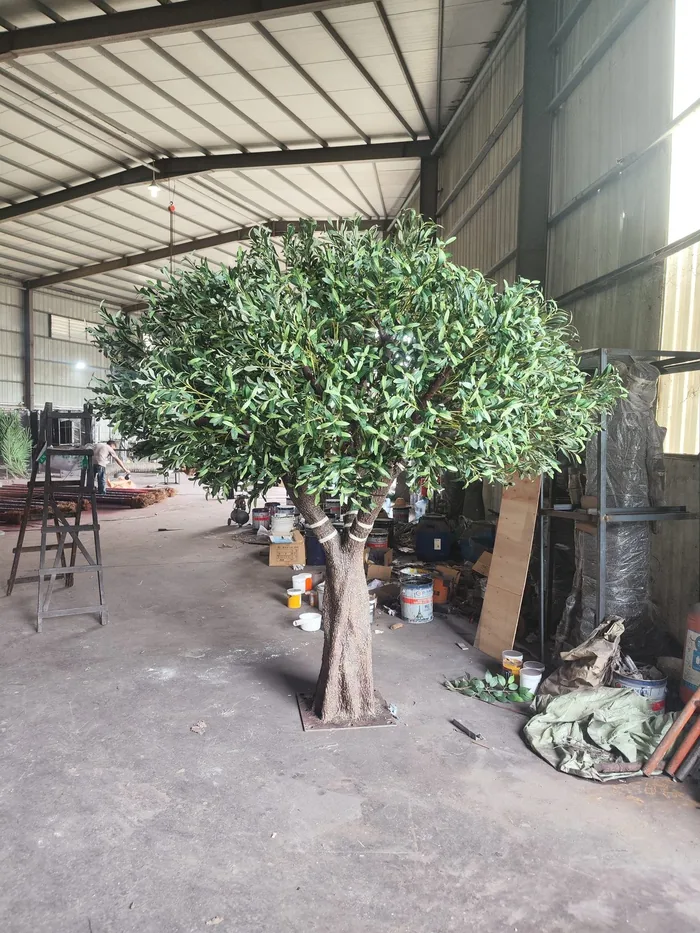
The tree decides the planter, so start at the core. Above 3 m, the structural spine is a galvanized steel tube rather than a timber or foam centre: 48 mm outside diameter and 2.5 mm wall at 3 m, rising to 76 mm at 5 m and 89 mm at 6 m, with continuous fillet welds at every branch collar. That progression exists because canopy deflection scales with the cube of the branch length — a 6 m specimen on a 48 mm core sags visibly within a season, and once a PE canopy takes a permanent set the tree reads as tired from the lobby floor upward. This is the same structural logic behind the olive builds used in atrium work, where the trunk is also the anchor interface.
Trunk skin is either treated natural wood or a centrifugally cast fibre-glass shell over the core. The cast shell carries a ring pattern and a bark grain that survives close inspection at 1 m, which is the distance a guest stands from a planter in a reception queue. Foam-skinned trunks are lighter and cheaper and read acceptably at 5 m in a photograph; at 1 m they read as foam, and the seam where the skin meets the planter collar is where the illusion breaks first.
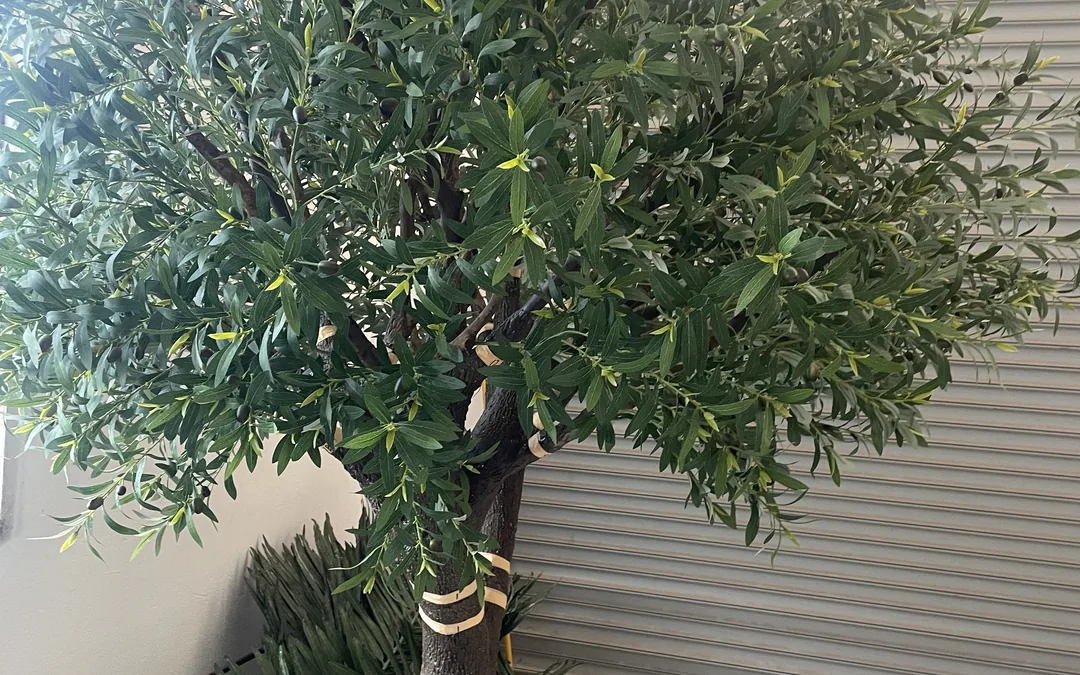
Foliage is injection-moulded PE, not silk. The measurable difference is leaf density and colour hold: 1,800–3,200 leaves per cubic metre of canopy volume, with moulded vein detail on both faces and a matte finish that does not flare under downlights. Silk foliage has a directional sheen that photographs badly in atriums and a crease memory that never fully recovers from compression. For a potted unit that will be handled, re-shaped and dusted for years, moulded PE is the only specification that survives the maintenance cycle.
The planter itself comes in three constructions, and the choice is a load question before it is an aesthetic one.
| Planter construction | Typical wall | Empty mass | Ballast capacity | Behaves like |
|---|---|---|---|---|
| Rotomoulded LLDPE | 4–6 mm | 8–14 kg | 80–260 kg of sand or gravel | Light, UV-stable, nests when empty, dents rather than cracks |
| Hand lay-up fibre-glass | 5–8 mm | 18–30 kg | 150–400 kg with a bonded insert | Stiff, repairable, heavier freight, needs a mould per size |
| Cast stone or GFRC | 25–40 mm | 60–140 kg | Self-ballasted | Permanent, needs structural floor checks, cannot be re-sited cheaply |
Two interface details decide whether the assembly works. First, the base plate: a concealed steel plate under the planter, chemically anchored to the slab, is the only fixing that survives cleaning machines and trolley impact without a visible bracket. Second, the collar: the gap between trunk and planter rim has to be closed with a gasket or a moulded collar, otherwise every cleaning cycle pushes dust into the cavity and every photograph shows a dark ring at the base.

3. Life Safety, Fire Codes & Environmental Compliance
Potted units raise a compliance question that bare trees do not: what exactly is being tested. The foliage is tested; the planter usually is not. For North American submittals the reference is NFPA 701, Method 1 for small-scale vertical burn and Method 2 where the authority having jurisdiction asks for the larger specimen. For European and GCC tender packages the usual line is EN 13501-1 Class B-s1,d0 on the foliage, with the test report naming the exact construction and colour, because a report issued for one foliage build does not automatically cover a different density or finish.
Two practical consequences follow. First, certificates have to be requested against the specification that will actually ship, with the tree height band and foliage code written into the report reference. Second, in Saudi Arabia the conformity route runs through SABER, and in the UAE through Civil Defence review at project level; both read the product certificate, not the sales brochure. Where a project requires the assembly rather than the foliage to be assessed, the planter material matters — a steel-reinforced fibre-glass shell behaves differently in a fire test from a 5 mm polyethylene shell, and the test house needs to know which one it is looking at.
Indoor air quality is the other compliance line. A sealed lobby with recycled air concentrates any residual styrene or solvent smell, and the complaint surfaces in the first week of operation, not at handover. Low-VOC polymer and water-based finish systems, plus a documented curing period before crating, are the controls. For projects pursuing LEED or Estidama credits, the material disclosure paperwork is easier to obtain at order stage than to reconstruct eighteen months later.
Whatever the certification route, the document set that clears a GCC submittal is the same: test report naming the construction, a declaration of conformity, a finish sample, and a dimensioned drawing of the unit as supplied — tree, planter and fixing, on one sheet.
4. Technical Comparison Table
The table below is the working specification for potted units. Ballast figures assume the planter carries the anchoring duty and the floor is a finished slab; where a concealed base plate is used instead, ballast can drop by roughly 40 percent, but the plate and its anchors become the critical item.
| Tree Height (m) | Min Core Steel Ø (mm) | Leaf Density (leaves/m³) | Floor Live Load & Ballast (kg) | Planter Volume (CBM) | Application | Indoor/Outdoor |
|---|---|---|---|---|---|---|
| 2.0 | 38 | 1,800–2,200 | 60–90 | 0.10–0.14 | Corporate HQ reception desk backdrop | Indoor |
| 3.0 | 48 | 2,000–2,600 | 110–150 | 0.16–0.22 | Airport VIP lounge corner grouping | Indoor |
| 4.0 | 60 | 2,200–2,800 | 170–220 | 0.24–0.34 | 5-star hotel atrium arrival axis | Indoor |
| 5.0 | 76 | 2,400–3,000 | 220–280 | 0.32–0.45 | Mall atrium centre court, tiered planter | Indoor |
| 6.0 | 89 | 2,600–3,200 | 280–360 | 0.40–0.55 | Seaside resort lobby, open to terrace | Indoor/Outdoor |
Two readings of the same table matter for ordering. Vertically, it is the engineering progression. Horizontally, read the planter volume column: 40 units at the 5 m line consume 13–18 m³ of planter volume before a single canopy is packed. That horizontal reading is where the freight argument lives, and it is the number to take into a consolidation discussion.
5. Structural Anchoring & MEP Coordination
There are two anchoring strategies and they are not interchangeable once the floor is finished. The concealed base plate is a steel plate under the planter, fixed with chemical anchors into the structural slab, with the planter dropped over it. It is the stiffer option and the one to specify where the floor is still bare concrete, because anchor holes drilled later through a polished stone finish are a visible repair. Ballast inside the planter is the retrofit option: no drilling, reversible, and adequate up to roughly 4 m of specimen height on a level floor.
Whichever is used, three MEP interfaces need checking on the drawing rather than on site. Sprinkler throw: a 6 m canopy placed under a standard upright head can shadow the spray pattern, and the fix is relocation, not a taller pot. Air curtains: a high-velocity curtain at an entrance drives a lateral load onto a tall potted unit that nobody calculated, and the unit needs either a plate fixing or a position outside the curtain line — a broad ficus canopy catches considerably more of that load than an olive of the same height. Floor loading: a 5 m potted unit at 260 kg ballast plus tree mass is a point load on a raised floor or a podium slab, and it has to be checked against the structural engineer's allowance rather than assumed, with the ballast figure coming from engineering calculations rather than a rule of thumb.
6. Commercial Contractor FAQs
Q: Is the planter's MOQ really separate from the tree's MOQ?
A: In most factories, yes. The tree line has a minimum expressed in units per model and height band; the planter line has a minimum expressed in units per mould and finish, because each size and colour is a separate production run. A 40-unit order of 4 m trees in three planter finishes can therefore clear the tree minimum and miss two of the three planter minimums. Ask for both minimums in writing, per line, before comparing quotations.
Q: Can the planters ship separately, and does that reduce cost?
A: It usually does, and it decouples the risk. Planters nest when empty, so a planter-only shipment of 40 units fits in far less volume than the same planters shipped with trees standing in them. The trade-off is a second freight movement and a second customs entry, which is only worth it when the planter quantity is large or the delivery is phased. Below roughly 20 units, shipping assembled is normally cheaper door to door.
Q: How many potted 5 m olive trees fit in a 40HQ?
A: About 14, planters included, when the canopy is compressed and the planters are packed as a separate nested line. That figure assumes roughly 4.5–5 m³ of packed volume per unit. Standing the tree in its planter for the whole voyage removes the nesting benefit and typically costs 3–4 units of capacity, which is where the freight argument becomes visible on the invoice.
Q: What lead time should be planned for a mixed tree-and-planter order?
A: Plan on production running in parallel, not in sequence: 25–35 days for both lines once the finish sample is signed off, then 18–28 days of sea freight to a Gulf port, plus clearance. The step that eats schedules is not production, it is the sample loop — a finish sample posted for approval and returned adds 10–14 days, and a rejected planter colour adds the full production window again.
Project Engineering Support & CAD Requests
We quote tree and planter as two lines and show both minimums on the same sheet, so the consolidation question is answered before the deposit rather than after. For a live project we can issue a dimensioned drawing of the assembly — tree, planter, base plate and anchor layout — plus finish swatches and the fire test reference for the foliage build you intend to order. Send the floor plan, the height schedule and the target opening date, and we will return a loading plan that shows how many units fit and where the empty volume sits. Our engineering team also runs the ballast and plate checks behind those options on request.
👉 Chat with Structural Engineering on WhatsApp (Instant Project Review)