Executive Summary
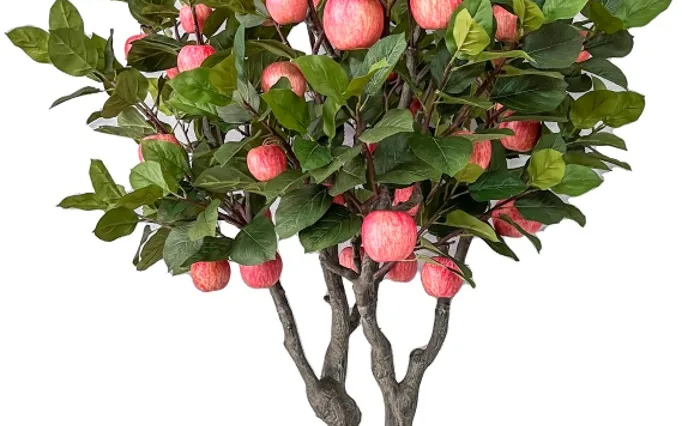
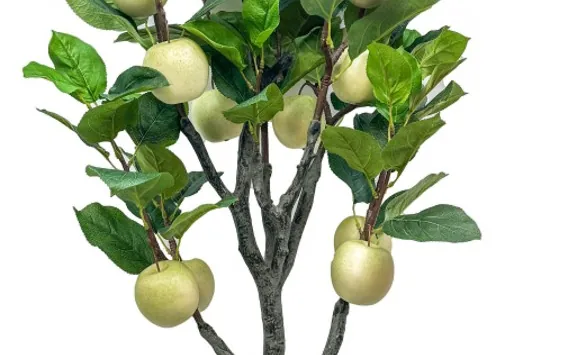
A practical home fruit tree set is three trees, not one: a 150 cm apple as the anchor, a 120 cm lemon or orange for a secondary room, and a 90–100 cm citrus for tabletop or balcony use. Assembly is branch-by-branch into a pre-finished trunk — fifteen minutes per tree, no tools — on a weighted base of 4–8 kg, shipped DDP to the door in 25–35 days by sea. Total upkeep after installation is a dust pass once or twice a year. That is the whole product; the sections below unpack what to check before ordering one.
1. What Goes Wrong Without This
Real fruit trees indoors fail for reasons no interior styling solves. Fruiting species need six or more hours of direct sun, which a living room with normal glazing cannot give; the tree drops leaves, the fruit never ripens, and within a season the pot holds a sad skeleton. Watering indoors means saucers, overflow stains on wood floors, and fungus gnats in the topsoil. Falling fruit — literal bruised apples on a carpet — is the detail that ends most household attempts. Families with children or pets add allergies and spray residue to the list, which is why the "grow a lemon tree at home" idea survives mostly on social media.
Cheap faux versions fail differently but just as visibly. Thin plastic trunks tip when a toddler grabs a branch; a 150 cm tree on a 1 kg base is a lever waiting for contact. Glossy injection fruit reads as plastic from two metres away, and the shine gets worse under spotlights. Glued fruit clusters pop off during unboxing — a shipment detail that matters more for fruit trees than any other species, because every fruit is a separate stress point. And the tell of the lowest-grade builds is smell: solvent-tinged polymer that off-gasses into a closed room for weeks, which defeats the point of bringing a tree into a family space.
The set-level failure is composition. Buying one statement fruit tree leaves the rest of the room unmatched — no height rhythm, no species echo — and a second order placed months later rarely matches the first batch's leaf tone. A set specified as one order, one colour window and one container solves that at the sourcing stage rather than the decorating stage.
There is also the cost-of-ownership arithmetic that households rarely run before buying live. A real indoor citrus needs a grow light (30–60 W running all winter in most climates), a humidity tray, quarterly fertilizer and replacement soil; over three years those running costs and the plant's own replacement price usually exceed the one-time cost of a well-built faux set — and the faux version holds its appearance on day one thousand, which the real tree never managed. The comparison is not an argument against living plants where light is genuinely good; it is an argument for matching the species to the room instead of the room to the species.
2. The Decision Framework
Check the following six items in order before paying for any home fruit tree set.
1. Trunk first. A convincing fruit tree lives or dies on the trunk: multi-stem or braided builds with bark texture cast from real wood, not a straight plastic tube. Bend-test in a showroom if possible; at home, the unboxing tells the truth — a trunk that arrives in one piece with branch sockets is a furniture-grade build, a trunk that arrives as segments is not.
2. Foliage material. Matte PE (polyethylene) leaves with vein relief hold realism under indoor spotlights and wipe clean; printed silk shines, creases permanently after the carton, and dusts grey at the edges. For a set that stands near a window, ask whether the foliage is UV-stabilised — balconies and sunrooms fade standard indoor pigment within one to two summers.
3. Fruit attachment. Every fruit should be wired into the branch, not hot-glued at a single point. Wired clusters survive shipping vibration and re-positioning; glued ones drop. This single check separates export-grade builds from gift-shop stock, and it is worth asking for a close-up photo of the attachment before ordering.
4. Base weight. The anchor tree (150 cm) needs 6–8 kg in its base; 120 cm trees run 4–6 kg; tabletop sizes 2–3 kg. The numbers exist for a physical reason — canopy leverage — and a supplier who cannot state base weight per height is reselling without inspecting.
5. Odour and safety. For enclosed family rooms, specify odour-free, low-VOC polymer grades and no-sap construction. Children touch fruit and leaves; pets chew lower branches. There is no certification theatre needed here — a material safety sheet and a "no smell after 48 hours in a closed carton" production test are the two documents that matter. The same documents double as the import paperwork in most destinations, so requesting them costs nothing extra in the order flow.
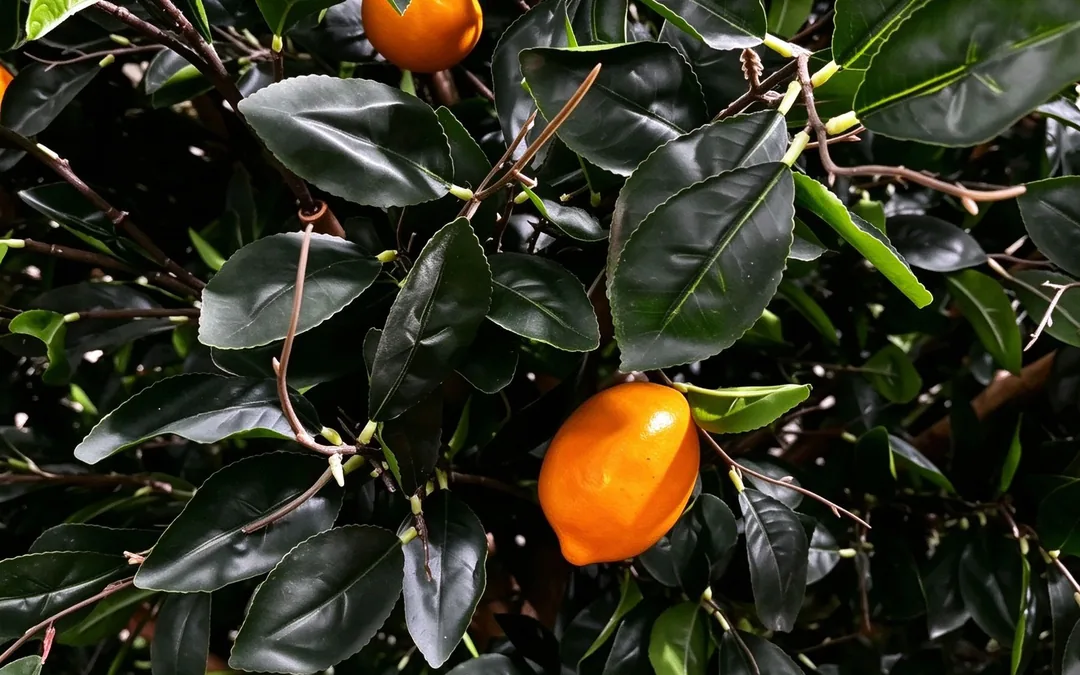
6. Set composition. Three heights, three rooms: anchor tree in the living space, mid tree in a hall or dining corner, small citrus on a console, kitchen island edge or balcony. Species should echo each other — apple plus citrus covers both the "orchard" look and the "Mediterranean kitchen" look in one set. Extending the set later is easier if the first order includes an olive tree slot in the same colour family, since olive foliage bridges almost any interior palette.
3. Numbers, Tiers and Timelines
| Set Piece | Height | Base Weight | Assembly (no tools) | Re-Positioning |
|---|---|---|---|---|
| Anchor apple tree | 150 cm | 6–8 kg | 15–18 min | Two-person lift |
| Lemon or orange tree | 120 cm | 4–6 kg | 12–15 min | One-person lift |
| Tabletop citrus (kumquat/mini lemon) | 90–100 cm | 2–3 kg | 8–10 min | One-hand carry |
| Optional olive companion | 140–160 cm | 5–7 kg | 12–15 min | One-person lift |
| Full three-tree set | — | 12–17 kg combined | 35–45 min total | Room-by-room placement |
Delivery and timeline numbers: sea freight in DDP terms runs 25–35 days door-to-door to most destination addresses, with air freight at 5–8 days for single sets when a room is waiting on a move-in date. Cartons are flat and stacked — a three-tree set ships in three to four boxes, the largest around 160 cm long, which passes a standard residential doorway and elevator without disassembly. Storage overhead after assembly is zero, which is the quiet difference between a fruit tree set and almost any other "plant" purchase: there is no seasonal care calendar, no replanting, no pruning window to remember. For gift buyers the same numbers translate simply — the set ships to a third address as easily as to the buyer's own, and the recipient's entire setup effort is one evening of branch sockets.
4. How to Apply It to a Live Project
Ordering works in one pass. Send the room dimensions and ceiling heights with the set request — 150 cm anchor trees need roughly 30 cm of canopy clearance above them to read as a tree rather than a bush — and confirm species mix, pot finishes and whether any unit will live on an uncovered balcony (that answer changes the foliage specification to UV-stabilised). During production, ask for the golden-sample photos of each tree in the set; fruit trees vary more between batches than foliage-only species because every fruit cluster is hand-wired, and a photo reference settles any later dispute about fruit density.
At delivery, DDP means the driver leaves full cartons at the door with duties paid — unbox indoors, keep the packaging for future moves. Assembly is branch sockets: trunk stands in its base, branches insert by size marking (largest at the bottom), fruit clusters are pre-wired and need only gentle arrangement. Fifteen minutes per tree is realistic without tools; a full three-tree set is a one-evening job. Placement follows light logic rather than plant logic — the trees do not need sun, so they go where the room needs them: anchor at the visual dead corner, citrus where the eye lands first. After that, the care schedule is a microfibre wipe or a cool-air dust pass once or twice a year, and nothing else. Browse the products range to see which fruit species are available as single units before committing to a set.
Room-level placement patterns repeat across homes enough to be worth naming. In a double-height villa living room, the 150 cm anchor sits beside the staircase stringer or under the return landing, where a real tree would face a draft and a light desert at once; the tabletop citrus goes on the piano or console where scale logic wants something small. In an apartment, the set splits across zones: lemon at the balcony threshold (the one position where a live citrus would actually have thrived — which is exactly the point being made), apple beside the media wall, mini citrus on the kitchen island edge away from the hob. Rental homes get their own benefit: the set is the only "planting" that survives a move, because it repacks into the same cartons it arrived in. And for households that rearrange seasonally, weighted bases with felt pads slide across hardwood without the scratching that light plastic pots with exposed rims inflict.
5. Commercial Contractor FAQs
Q: Are artificial fruit trees safe around children and pets?
A: Specify low-VOC, odour-free polymer foliage and wired fruit attachment, and ask for the material safety sheet with the order. There is no sap, no pollen and no pesticide residue; the main physical consideration is base weight, which is why the anchor tree carries 6–8 kg. Lower branches on PE builds spring back rather than snap when grabbed.
Q: How hard is assembly for someone who has never handled a faux tree?
A: Branch-by-branch into marked sockets on a pre-finished trunk — no tools, no wiring. Fifteen minutes per tree is a realistic first-time figure, and the largest carton still passes a standard residential door. The only step worth care is arranging fruit clusters after assembly, and even that is reversible.
Q: Can the set live on a covered balcony or by a full-height window?
A: Covered and glazed positions are fine with standard foliage. For open balconies in strong-sun climates, order the UV-stabilised foliage version — standard indoor pigment fades within one to two summers behind glass, faster in open air. Wind exposure is handled by base weight rather than fixing: a 6–8 kg base holds a 150 cm tree in typical balcony conditions.
Q: What does DDP delivery actually include?
A: Door delivery with duties and clearance handled before arrival — the set leaves the cartons at the address, not at a port or a customs office. Sea freight runs 25–35 days to most destinations, air freight 5–8 days for urgent move-ins. Keep the cartons after assembly; the flat-pack design repacks for a future house move.
Q: How long does the finish hold up indoors, and what ages first?
A: In an indoor position away from direct glazing, matte PE foliage holds colour for years; the first thing to age in any faux fruit tree is the fruit coating, because it is the most handled part. Wiping fruit with a dry cloth during the annual dust pass preserves the matte finish — solvents and abrasive cloths are what turn a satsuma shiny, not sunlight. Trunks and bases do not age in normal room conditions; the only structural check worth doing annually is confirming branch sockets still seat fully after any house move.
Project Engineering Support & CAD Requests
For homeowners and interior studios assembling a set, our team quotes the three-tree structure directly: send room heights, species preferences and balcony exposure, and we return a per-tree specification — trunk build, foliage grade, base weight and the DDP delivery plan. We can supply golden-sample photos per tree, pot finish options and mixed-set consolidation so the whole set ships in one container window. Message the engineering desk on WhatsApp for a set configuration review:
👉 Chat with Structural Engineering on WhatsApp (Instant Project Review)