Executive Summary
A showroom with 60–120 m² of retail floor can stock three fast-moving groups — bird of paradise at 1.5–1.8 m, monstera at 0.9–1.2 m and hanging ferns at 0.5–0.7 m — inside 6–8 m³, which is an LCL shipment rather than a container. At 0.24–0.35 m³ per bird of paradise carton and 0.05 m³ per fern, that volume carries roughly 55–85 units across 8–12 SKUs.
1. What Goes Wrong Without This
A small plant retailer that orders badly does not usually order too little. It orders one thing well and everything else badly, and the mistake shows up as cash sitting on the floor in the wrong species.
The first order is built around one hero SKU. A new showroom buys 60 bird of paradise because the supplier's photo looked strong, and discovers in week three that the local market wants 12 of them a month and 25 monstera. The remaining 48 bird of paradise occupy the prime floor positions for a season, and the capital tied in them is the capital that should have funded the second and third delivery.
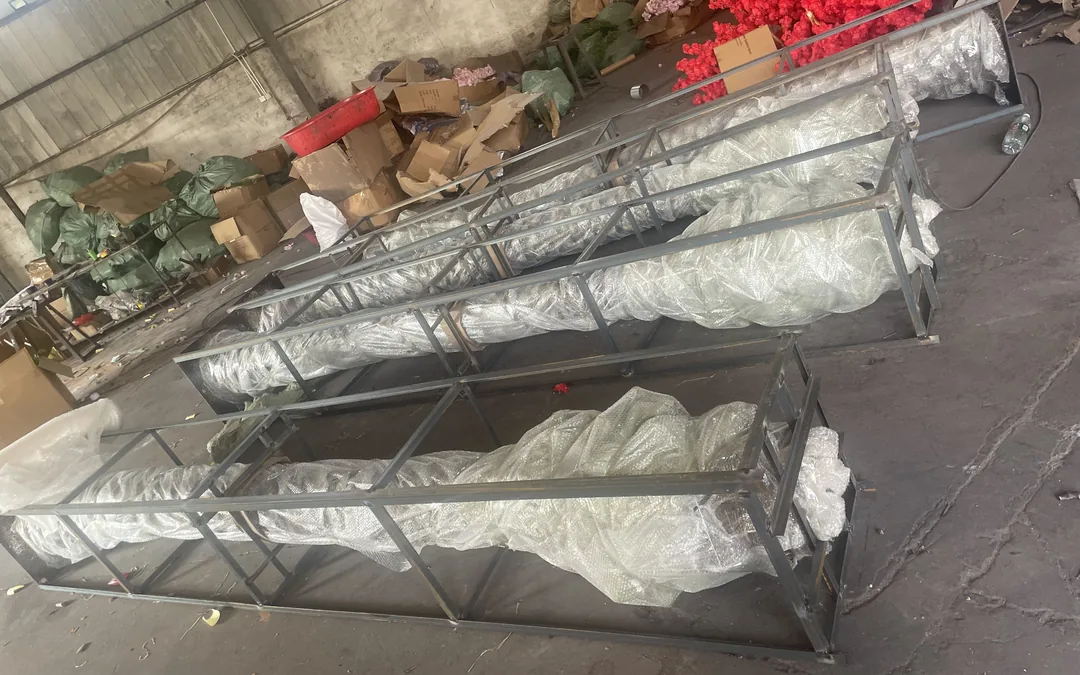
Volume is bought in kilos of carton, not in units of demand. A 1.8 m bird of paradise ships in a carton of roughly 0.45 × 0.45 × 1.75 m, about 0.35 m³. Twenty of them are 7 m³, which is an LCL booking on its own. A buyer who plans by unit count and not by carton volume finds that the "small trial order" has become a shipment with its own freight minimum, and the freight per unit is higher than the margin on the unit.
Ferns are treated as filler and arrive crushed. Hanging ferns ship in flat cartons of 0.04–0.06 m³ and are usually packed at the bottom of a mixed load unless the packing list says otherwise. They arrive with fronds folded into the pot and take a week on the shelf to recover, which is a week of a display that looks second-hand.
The reorder is placed when the shelf is empty. Sea freight from China to a Gulf port runs 18–25 days door to door on a consolidated LCL, and production adds 7–10 days for standard builds. A store that reorders at zero stock is out of its top seller for five to six weeks, and the customer who wanted it buys a different species from a competitor and does not come back for it.
Spares are not budgeted. In a mixed carton load, 3–6% of units arrive with a bent stem or a scuffed pot. Without a spare allowance, the damaged unit is either sold at a discount or written off, and the write-off is charged against a margin that was calculated on perfect goods.
The mix ratio is copied from a catalogue instead of a floor. Suppliers publish a recommended assortment built for a 300 m² store. Applied to a 70 m² showroom, it produces 40 SKUs at two units each: nothing looks abundant, nothing can be reordered sensibly, and the display reads as samples rather than stock.
2. The Decision Framework
The framework below is the one a showroom owner can apply without a merchandising consultant. Each test produces a number, and the numbers together decide what goes in the first mixed order.
Test 1 — Floor positions, not square metres. Count the positions where a plant can stand and still be walked around. A 1.5 m bird of paradise needs about 0.6 m² of footprint plus 0.4 m of circulation, so a 70 m² showroom with a counter and a window typically holds 18–26 floor positions. Stock should be 1.5 to 2 times the position count: enough to rotate, not enough to stack in the back room.
Test 2 — Sell-through per four weeks. Take the units sold in a normal month and divide by units on display. A ratio below 0.4 means the display is overstocked in that species; above 1.2 means the shelf is empty too often. The target band is 0.6–1.0, which corresponds to roughly 1.5–2.5 inventory turns a year on the fast movers.
Test 3 — Carton volume per unit of margin. Rank the assortment by cubic metres per unit, not by unit price. A hanging fern at 0.05 m³ and a 1.8 m bird of paradise at 0.35 m³ differ by a factor of seven in the space they consume, and freight is charged on the space. The mix that fills a container well is the mix where the low-volume items subsidise the volume of the tall ones.
Test 4 — Six-week cover, not three-month cover. With 18–25 days of transit and 7–10 days of production, a 30-day reorder point leaves the shelf empty before the next shipment lands. Six weeks of cover on the top three sellers, four weeks on the rest, is the band that keeps the display full without freezing cash.
Test 5 — A spare allowance of 8–12% on the top sellers. Damage in a mixed load concentrates on the tallest cartons and on anything with a soft frond. Eight to twelve percent spare on the three fastest movers covers replacement without a second shipment, and the spares sell at full price once the season turns.
Test 6 — A 60/30/10 split. Sixty percent of the spend goes to proven sellers, thirty percent to complementary items that complete a display (a planter line, a floor specimen that anchors a corner), ten percent to a test group of two or three new species. The test group is allowed to fail; the sixty percent is not.
Test 7 — One pot standard. Mixed orders go wrong when every SKU arrives in a different pot colour and size. Fixing one pot family — 30 cm, 40 cm and 50 cm diameter in a single finish — makes the display cohere, lets pots nest in transit, and cuts the crated volume of the pot line by 35–45% because nested pots ship as a stack rather than as individual units.

3. Numbers, Tiers and Timelines
| Order tier | Crated volume | Typical unit mix | Production plus transit | Reorder interval | Floor coverage |
|---|---|---|---|---|---|
| Trial LCL | 2–4 m³ | 18–28 units, 4–6 SKUs | 30–40 days door to door | Once, to test the market | One window and one corner |
| Standard LCL | 6–8 m³ | 55–85 units, 8–12 SKUs | 32–45 days door to door | Every 8–10 weeks | 18–26 floor positions |
| 20GP shared | 26–28 m³ | 180–240 units, 12–16 SKUs | 30–42 days port to port | Every 12–16 weeks | Full showroom plus stockroom |
| 40HQ split with a second store | 64–66 m³ | 380–460 units, 16–20 SKUs | 28–40 days port to port | Twice a year | Two showrooms plus spares |
Two numbers in that table matter more than the rest. The 8–10 week reorder interval on a standard LCL is what the cash cycle has to survive: at 30% deposit and 70% before shipment, the money leaves twice inside one cycle, and the goods land once. The 0.24–0.35 m³ per tall carton is what decides whether a trial order is a trial or a commitment, because freight minimums are charged on volume, not on intent.
The mix that fills 6–8 m³ profitably usually looks like this: 12–16 bird of paradise at 1.5–1.8 m, 20–26 monstera at 0.9–1.2 m, 18–24 hanging ferns at 0.5–0.7 m, and 6–10 floor specimens in a larger size to anchor the window. That is 56–76 units, 6.2–7.8 m³, and it fills a showroom without a stockroom the size of a garage.
4. How to Apply It to a Live Project
The sequence below is the one that keeps a mixed order from turning into a storage problem. It runs from first enquiry to shelf, and each step has a document that the next step depends on.
Enquiry: give the supplier a floor plan, not a wish list. A plan with position count, ceiling height and the door width is what allows a supplier to propose a mix that physically enters the store. Door width matters more than buyers expect: a 1.9 m assembled specimen does not pass a 0.9 m service door unless the crown is detachable.
Sampling: ask for one unit of each of the three core species. A single bird of paradise, one monstera and one fern, shipped as a sample carton, cost far less than discovering the foliage colour is wrong across 60 units. Compare the sample against the local light: a green that reads well in a factory photo can read blue under 4000 K retail lighting.
Order confirmation: fix the packing list before the deposit. The packing list should state cartons, pieces per carton, net and gross weight, and cubic metres per line. That document is the freight quote, the customs declaration and the receiving check in one, and it is the only place where a low-MOQ order can be verified before money moves.
Production: keep one pot family and one foliage tone across the order. Colour variation between production batches is the most common complaint in a mixed load, because different SKUs are often run at different times. Specifying a single tone reference and a pot family removes most of it, and it lets the retailer photograph the whole display as one collection.
Shipping: consolidate, then deconsolidate. An LCL booking shares a container with other shippers, so the cartons need corner protection and a packing list that survives being handled by a third party. Where the volume reaches 13–14 m³, a 20GP usually beats LCL on landed cost per unit, and the break-even sits lower than most buyers assume.
Arrival: check three things before signing. Carton count against the packing list, pot diameters against the order, and foliage colour against the sample. Damage claims on a consolidated load are decided by photographs taken at the receiving dock, not by a description sent a week later.
Shelf: rotate on a fixed cycle. Put the newest delivery at the back and the older stock at the front, and reorder when the front row is down to two units rather than when it is empty. This single habit is what keeps a 6–8 m³ order repeating every eight to ten weeks instead of every five months.
5. Commercial Contractor FAQs
What is the minimum order for a mixed load of three species? The order minimum sits at shipment level rather than per SKU: 2–4 m³ for a trial, 6–8 m³ for a working showroom assortment. Within that volume the species mix is open, which is what allows a small store to carry bird of paradise, monstera and ferns in one booking instead of three.
How many units fit in 6 m³? About 55–85 units at the sizes a showroom sells, because a 1.8 m bird of paradise carton is 0.35 m³ while a hanging fern is 0.05 m³. The exact count depends on the tall-to-short ratio: a mix weighted to floor specimens carries 45–55 units, a mix weighted to ferns and monstera carries 80–95.
How long does a reorder take from confirmation to shelf? Thirty-two to forty-five days door to door on a consolidated LCL, made up of 7–10 days of production for standard builds, 3–5 days of consolidation, and 18–25 days of sea transit plus clearance. Custom heights and finishes add 15–20 days of production, which is why the reorder point is set at six weeks of cover.
Should a small showroom buy a 20GP instead of LCL? At 13–14 m³ the 20GP usually wins on landed cost per unit, and at 6–8 m³ LCL is still the better choice. A 20GP holds 26–28 m³ of usable volume, which is three to four times a showroom assortment — the right answer is usually a shared container with a neighbouring store rather than a full box for one shop.
Project Engineering Support & CAD Requests
We build mixed orders around a showroom's floor plan rather than a catalogue page, because the carton volumes and the door width decide what a store can actually receive. Send us the position count, the ceiling height and the species you want to test, and we will return a packing list with cartons, pieces, weights and cubic metres per line, a pot family that nests, and a production schedule that fits the reorder interval you need. For a first order the sample carton ships before the deposit, and for a repeat order the packing list is issued against the same carton sizes so the freight quote does not move. Where a store also supplies fit-out projects, the same account can cover a restaurant ficus or a pachira alongside the retail range, and a bespoke size is handled through custom solutions rather than a new supplier.
👉 Chat with Structural Engineering on WhatsApp (Instant Project Review)